

What's the Best Butcher Block Top for a Kitchen Island?
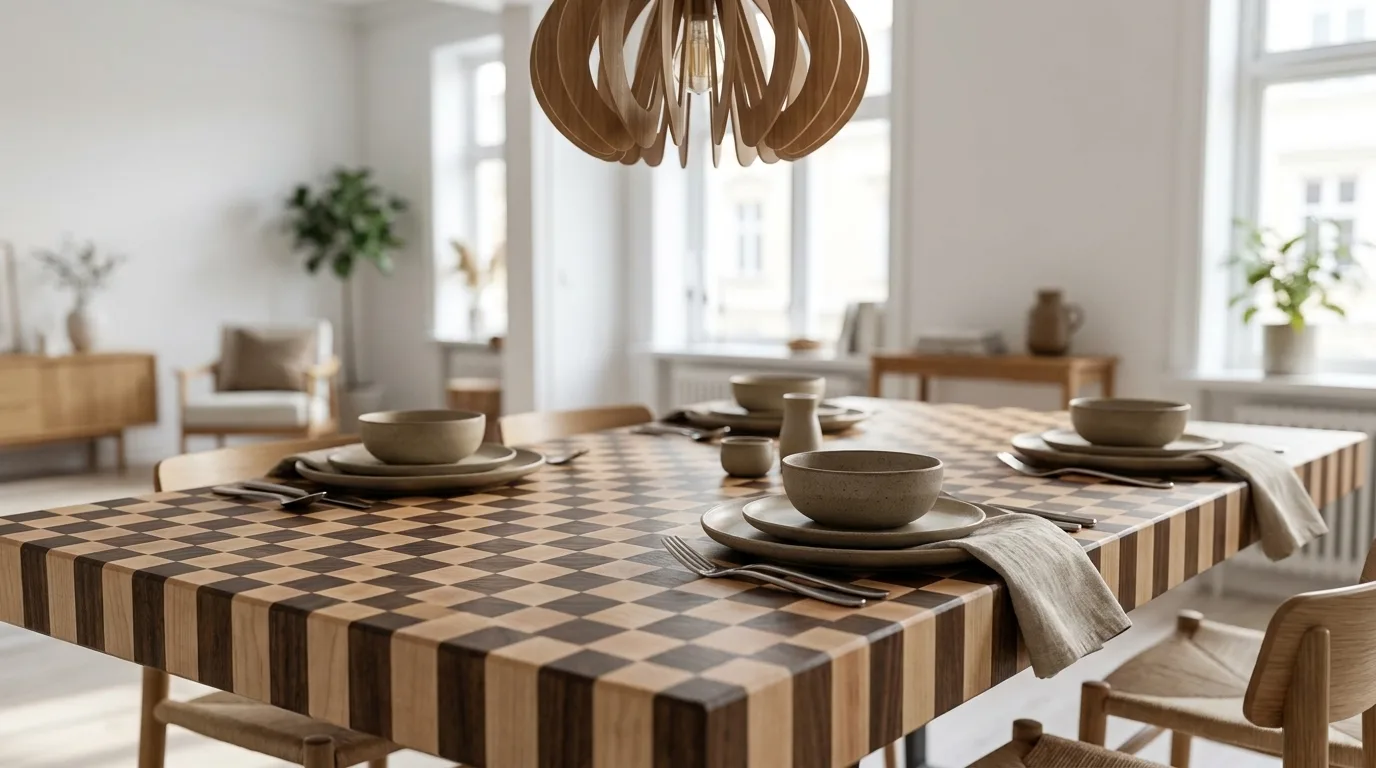
An island top works harder than any other counter in the house — it's the prep surface, the breakfast bar, and the thing every guest leans on. "Butcher block" covers three different builds, and the right one depends on whether the island is a showpiece, a workbench, or both. We build all three in the Farmingdale, NY shop; here's how to choose, with real numbers.
Edge Grain, End Grain, or Two-Tone — Which One for an Island?
Edge grain is boards glued on edge with the long grain running the length of the top — the standard island construction because it's the most dimensionally stable across a wide span and shows clean, linear stripes. End grain is the true butcher block: hundreds of blocks stood on end so the fibers point up, a cutting board scaled to six feet. Two-species stripes — maple and walnut, or walnut and white oak — are edge grain construction with alternating woods, and they photograph better than almost anything else in a kitchen.
- Edge grain: the workhorse. Stays dead flat on big islands, takes sink cutouts happily, easiest to refinish, lowest cost of the three. Use a board for daily chopping.
- End grain: the working surface. Kindest to knives and self-heals small cuts, at about 50 percent over face grain cost for the same footprint. More attention at the sink — every glue line is exposed end grain.
- Two-tone: same durability as single-species edge grain; the contrast is purely a design decision, with a modest upcharge for the second species.
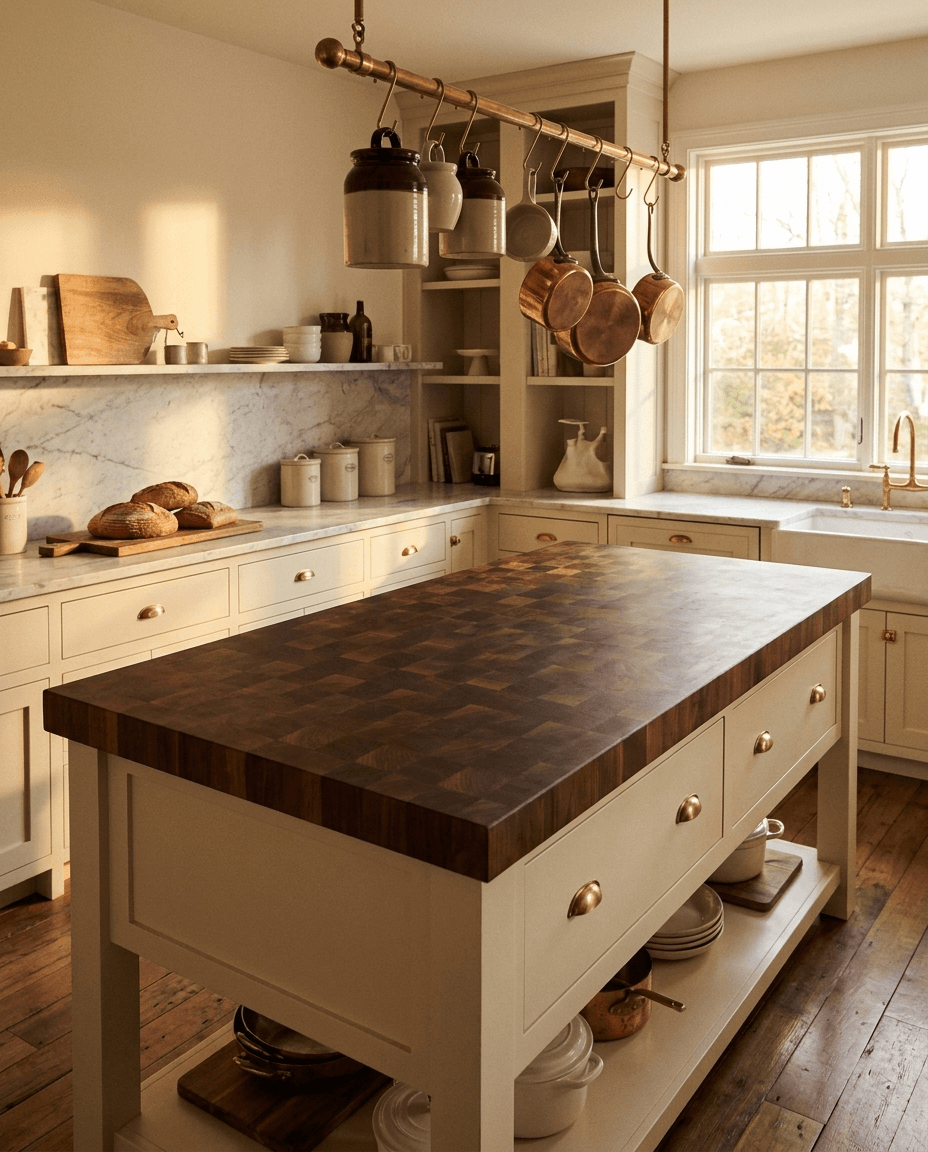
End grain walnut at chopping-block thickness — order this build when the island IS the cutting board.
The full head-to-head is in edge grain vs. end grain butcher block, and the whole countertop decision tree lives in the butcher block countertop guide. For edge grain in a real kitchen, see the walnut countertop with undermount sink we built.
How Thick Should an Island Butcher Block Be?
1.5" is the minimum we'll build for an island — thinner reads slight next to standard cabinetry and can't take an undermount sink without extra blocking. 2" is our most common island thickness: substantial without absurd weight. Past 2.25" the top gets heavy fast — a 4' × 8' walnut top at that thickness is a crew set, not a two-person carry, which changes the delivery plan. End grain runs 2.5" and up because the construction demands it. Overhangs past 12" for seating want brackets or steel; spans past 8 feet want C-channel reinforcement let into the underside.
Is End Grain Actually Food-Safe?
Yes — and the finish matters more than people think. Every top we ship is sealed with a 100% VOC-free, food-contact-safe hardwax oil, UV-cured in the shop to full hardness, never polyurethane — a hard film finish cracks along end grain joints within a year of knife work. Unlike raw-oiled butcher block, there's no monthly oiling ritual: plan on a refresh coat about once a year in the hardest-working zone, applied with a cloth in minutes. On a true end grain work surface, re-oil the chopping zone as it visibly wears. If you rarely cut directly on the wood, edge grain is the lower-maintenance, more honest recommendation — we'll say that up front even though end grain has the bigger reputation.
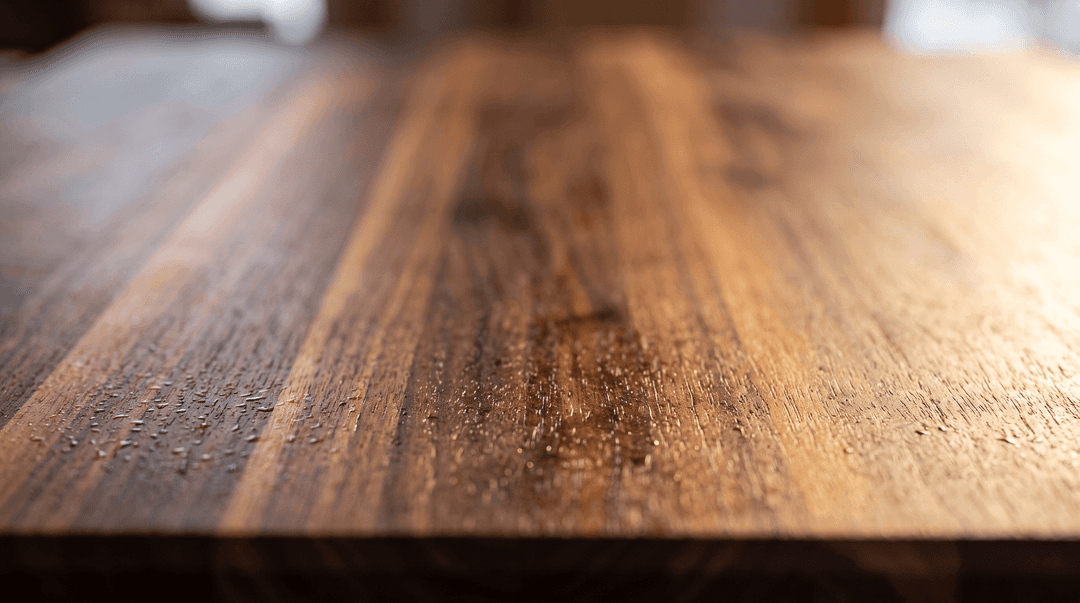
The hardwax oil beading water — food-safe, repairable in place, no oiling schedule.
What an Island Top Costs, in Real Numbers
Per square foot at the standard 1.5" thickness, finished and freighted: maple $85–$105, white oak $80–$100, walnut $90–$110. Edge grain prices about 20 percent over face grain; end grain about 50 percent over. Worked example: a 3' × 6' walnut island at 2" in edge grain lands roughly $2,200–$3,400 depending on cutouts and edge profile; the same footprint in end grain runs $3,400–$5,000 on block-count labor alone. Two-tone lands near single-species edge grain plus a modest second-species upcharge. Sink or cooktop cutouts are $150 flat, CNC-cut to your template — details on the sink cutouts page. Per-species rates are on the pricing page; the Builder shows your exact figure live.
Lead Time
Current lead time is 4-6 weeks from order confirmation — end grain sits at the top of that window because the block construction is glued in stages and milled flat without tear-out. Every top ships crated on a pallet, lift-gate freight included in the continental US.
Spec Your Island
Pick the species, choose edge or end grain, enter your island's exact dimensions, and the Builder prices it live — cutouts and C-channel included. If maple is on your shortlist, the deep dive is in maple butcher block countertops. See the two-species build first: our maple and walnut edge grain countertops are milled to exactly the specs this guide recommends.
piece, cut to your dimensions.
Each one is milled from solid hardwood to your exact measurements and finished by hand in our Farmingdale shop.
Design yours →Kevin has been designing and building made-to-order solid hardwood countertops, table tops, and shelving in Farmingdale, NY since 2017 — every piece milled and finished in the Hardtwood shop.
More about the shop →