

Maple Butcher Block Countertops: Hard Maple vs. Soft Maple, Construction, and Cost
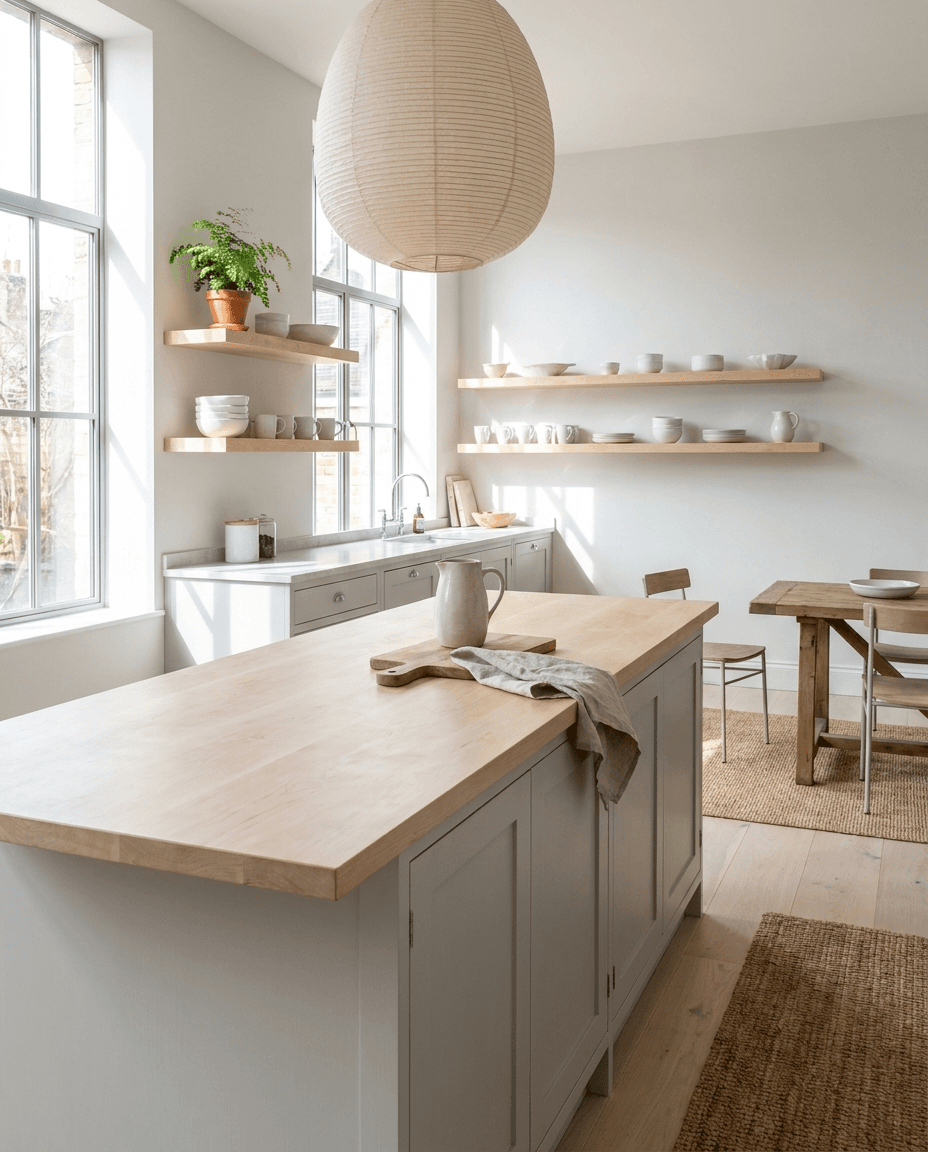
Maple is the wood butcher block was built on. Before walnut became the photograph everyone wanted, the working surfaces of American kitchens — meat-packing benches, bakery counters, school shop tables — were hard maple, because no other domestic wood combined that hardness with a grain tight enough to wipe clean. What has changed is that "maple butcher block countertop" now covers everything from a 1,450-lbf sugar maple top milled to order down to a finger-jointed panel that may not be hard maple at all. This is how to tell them apart, what each construction is for, and what a custom maple top costs in real numbers.
Hard Maple vs. Soft Maple: the Difference You Cannot See in a Photo
"Maple" is a family, not a species, and the gap inside the family is wide. Hard maple — sugar maple, Acer saccharum, sometimes sold as rock maple — rates about 1,450 lbf on the Janka hardness scale. That is harder than white oak at 1,360 and roughly 45 percent harder than walnut at 1,000. Soft maple is a lumber-trade name for several species, mainly red maple and silver maple, which land between roughly 700 and 950 lbf. Both are pale and fine-grained, and finished side by side they can look nearly identical.
In a countertop the difference shows up in year three, not on delivery day. Hard maple shrugs off a dropped cast-iron pan and the scuff of a bar-stool back; soft maple dents where the pan lands and bruises along the front edge. Hard maple also holds a crisper edge profile, because its fibers cut instead of tearing under the router.
Hardtwood Custom Woodworks mills only hard maple, hand-picked for color and grain in the Farmingdale, NY shop, and every top leaves as solid hardwood straight through — never veneer over MDF or particleboard. If a listing says "maple" without saying which maple, assume soft until proven otherwise. Ask for the Janka number. If nobody can give you one, that is the answer.
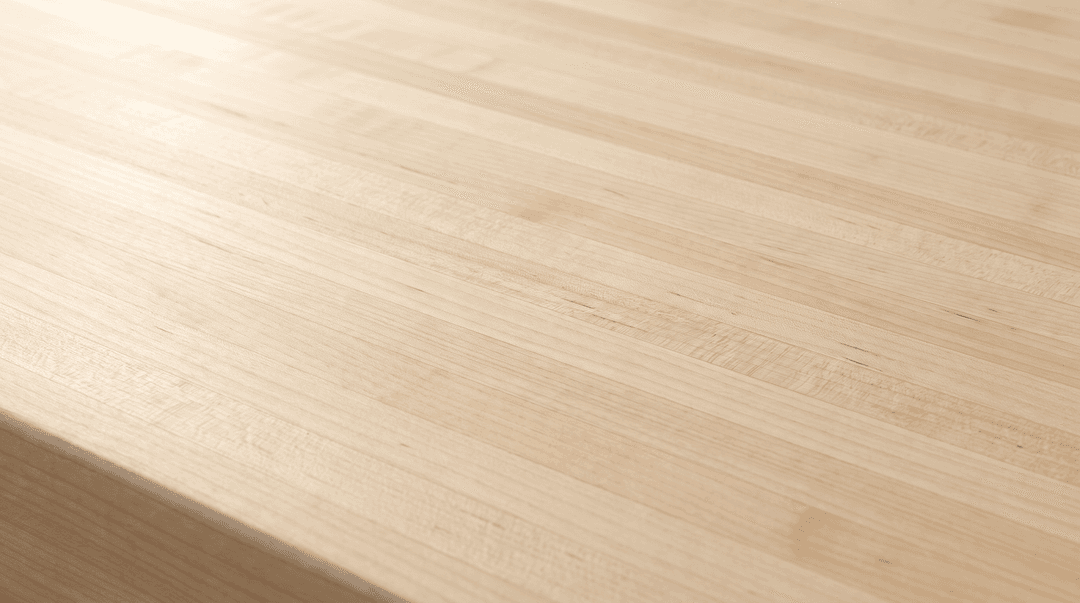
Hard maple, edge grain, clear-coated — the tight closed grain that wipes clean.
Face Grain, Edge Grain, End Grain: Three Tops, Three Jobs
Construction matters as much as species, and strictly speaking only two of the three builds are butcher block.
Face grain is wide boards laid flat and glued edge to edge, so the top shows the full cathedral figure of each plank. It is the furniture look and our standard build. A maple face grain countertop reads as long, quiet, nearly uniform grain — the cleanest surface in the catalog for a modern kitchen. Cut on a board, not on the top.
Edge grain turns those same boards on edge and glues them face to face, producing the narrow parallel stripes most people picture when they hear the words butcher block. It is the most dimensionally stable of the three across a wide island and the most forgiving to refinish; at Hardtwood it prices 20 percent above face grain for the extra rip cuts and glue-up.
End grain stands short blocks on end so the fibers point at the ceiling. A knife slides between the fibers instead of severing them, which is why end grain is the only build we would call a true cutting surface. It costs about 50 percent more than face grain at the same footprint, can be built up to 6 inches thick, and asks for more attention at the sink because every glue line is exposed end grain. The comparison in edge grain vs. end grain countertops covers where each belongs in more depth.
For a kitchen run or an island that sees prep work on a board and everything else directly on the wood, hard maple in face or edge grain is the right answer nine times out of ten. Order end grain when the top is the cutting board.
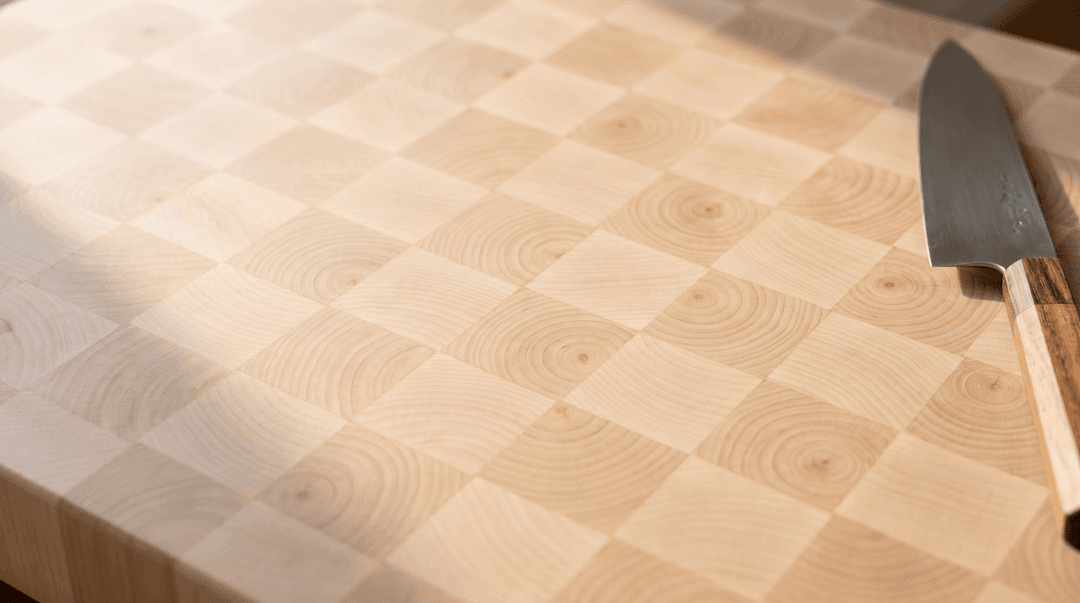
End grain hard maple — the checkerboard is the cutting surface, and the build to order when the top is the board.
Thickness, Span, and What the Top Weighs
The Builder defaults to 1.25 inches, which is enough for a run of counter supported by cabinets along its full length. We build most maple islands at 1.5 inches, the thickness our per-square-foot prices are quoted at, and go to 1.75 or 2 inches when the top overhangs a seating side by more than 12 inches or needs to read heavier next to tall cabinetry. End grain can go to 6 inches for a chef's block.
Maple is dense, so plan the carry. The Builder estimates about 60 pounds for a 48 by 24 by 1.25-inch top and scales from there; an 8-foot island at 1.5 inches is a two-person lift and ships crated on a pallet with lift-gate freight included in the continental US. Spans over 8 feet, or any overhang carrying stools, can take optional steel C-channel let into the underside at $100 per foot of width. It keeps a wide top flat through winter heat and summer humidity without a visible apron.
What a Maple Butcher Block Countertop Costs
Real numbers, because "butcher block" has become a pricing fog. At a standard 1.5-inch thickness, a finished Hardtwood maple top runs $85 to $105 per square foot with fabrication, the UV-cured finish, and lift-gate freight included. That puts maple a step above white oak ($80 to $100) and a step under walnut ($90 to $110). The Builder starts a 48 by 24 by 1.25-inch maple face grain top at $520, and the price moves with the wood in the piece — length times width times thickness — plus one fabrication rate that covers milling, glue-up, CNC flattening, hand sanding, and finish.
Worked examples at 1.5 inches, freight and finish included:
- 96 by 25-inch kitchen run, face grain: about 25 board feet, roughly $1,500
- 72 by 36-inch island, edge grain: about 27 board feet, roughly $1,900 to $2,200 with the edge-grain premium
- 60 by 30-inch prep island, end grain at 2.5 inches: roughly $2,700 to $3,300, driven by material volume and block glue-up labor
Add-ons are flat: a sink or cooktop cutout is $150, a mitered L-return is $150, and C-channel is $100 per foot of width. The Builder shows the exact figure for your dimensions before you give us an email address.
A big-box maple panel competes on the sticker, not the spec: typically 1.5 inches thick, 25 inches deep, unfinished, edge-grain from random-length strips, and sold as "maple" with no Janka rating attached. Add finishing, a sink cutout, and the length you actually need, and the gap narrows — and the species question never gets answered.
Maple and Color: Ambering, Stains, and the Finish That Decides It
Fresh-milled hard maple is cream to pale straw with an occasional mineral streak. Two things move it from there.
The first is light. Maple ambers with UV exposure — more noticeably than walnut lightens — and an oil-based polyurethane pushes it toward yellow faster than anything else. Our finish is a 100% VOC-free, food-safe hardwax oil, cured under UV in the shop. It adds a slight warmth on day one and then changes slowly, so a top ordered pale stays pale.
The second is stain. Maple's closed grain takes color evenly but lightly: the same Charcoal or Chocolate that reads deep on oak sits cooler and a shade lighter on maple, which is why we photograph every stain on every species instead of printing one swatch card. Black on maple is a clean, modern near-black without oak's open-pore texture. Pure — the clear coat — is the finish we recommend first on maple, because the wood's own color is the point.
If you want a two-tone top, maple pairs with walnut better than any other species we stock. The maple and walnut edge grain countertops we build use the same 1.5-inch strips in both woods, so the joints stay flush through the seasons and the contrast does the work.

Maple + walnut, striped through the glue-up — shown here on a dining top; the countertop build is the same strips.
Care, Food Safety, and How Long It Lasts
Day to day, a hardwax-oiled maple top is cleaned with mild soap and water. The finish is repairable in place: a worn patch beside the sink gets scuffed and re-oiled without stripping the whole top, which a film finish cannot do. In a working kitchen, plan on one refresh coat a year in the highest-wear zone and nothing more.
Cut on a board unless you ordered end grain. Wipe standing water at the faucet. Beyond that, a hard maple top at 1.5 inches carries enough material to be sanded and refinished several times across decades — the real reason it beats laminate on cost per year, and why the old meat blocks are still in service.
Spec Your Maple Top
Pick hard maple, choose face, edge, or end grain, enter length, width, and thickness, and the Builder prices the top live with finish and freight included. Current lead time is 4-6 weeks, and every piece ships crated from Farmingdale, NY.
Maple countertop, cut to your dimensions.
Each one is milled from solid Maple to your exact measurements and finished by hand in our Farmingdale shop.
Design yours →Kevin has been designing and building made-to-order solid hardwood countertops, table tops, and shelving in Farmingdale, NY since 2017 — every piece milled and finished in the Hardtwood shop.
More about the shop →