

What's the Best Wood for a Table Top — Edge Grain, End Grain, or Two-Tone?

For most dining tables and everyday counters, edge grain is the right build — strong, economical, clean linear grain. End grain is the right call when the surface takes real knife work, because the upright fibers absorb the blade and close back up. Two-species tops — walnut and white oak, maple and walnut — are a design decision, not a durability upgrade. Here's each build in detail, how we make them, and what they cost.
Edge Grain: The Standard for Dining Tables
- Durability: excellent — boards glued on edge move as one stable panel across a wide top.
- Cost: the most economical of the three; about 20 percent over a face grain plank top for the extra rips and glue-up.
- Maintenance: our UV-cured hardwax oil arrives at full hardness — plan a refresh coat about once a year in the hardest-used zone, nothing more.
- Best use: dining tables, conference tables, kitchen counters that see boards, not blades.
Our Vekt walnut dining table in Tenafly, NJ and the expandable live edge walnut table in Huntington Station are both edge grain builds — the construction disappears and the walnut does the talking.
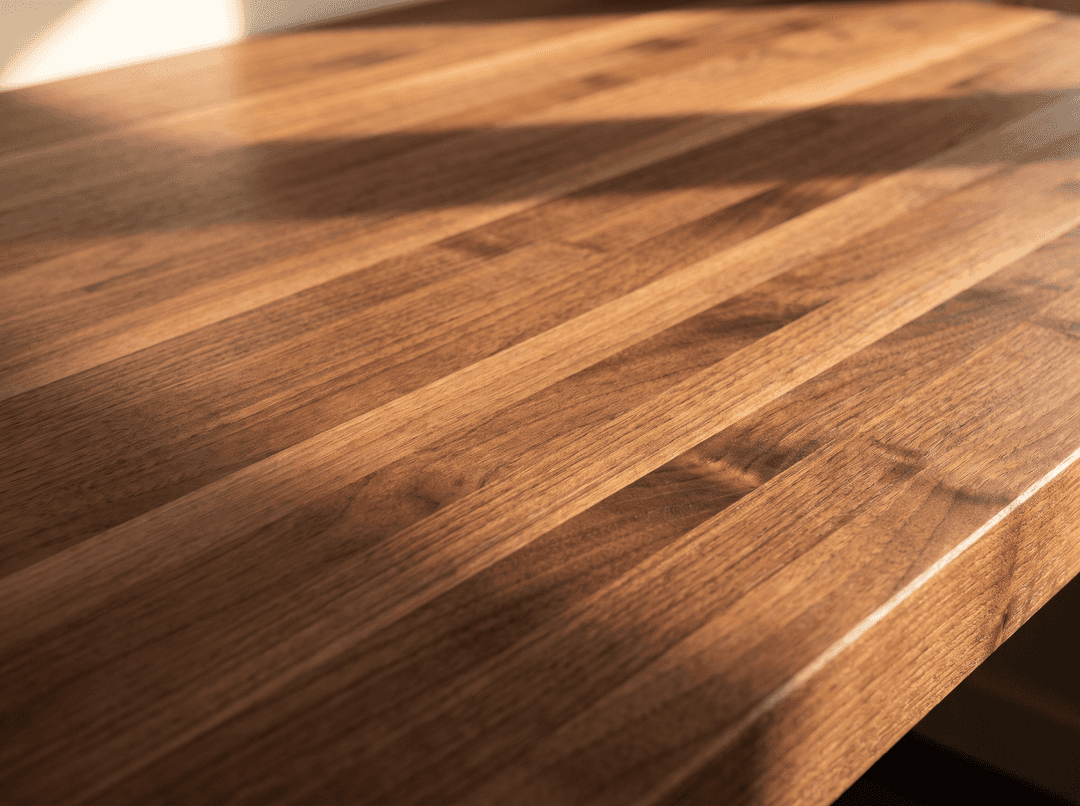
Edge grain up close: parallel strips, one stable panel.
End Grain: Butcher Block for Real Knife Work
- Durability: the best surface there is for cutting — fibers absorb the blade and self-heal with oil.
- Cost: the highest — about 50 percent over face grain at the same footprint, on block-count labor alone.
- Maintenance: re-oil the working zone as it visibly wears; more forgiving of surface scars than any other build.
- Best use: restaurant prep tables, chef's counters, islands that double as the cutting board.
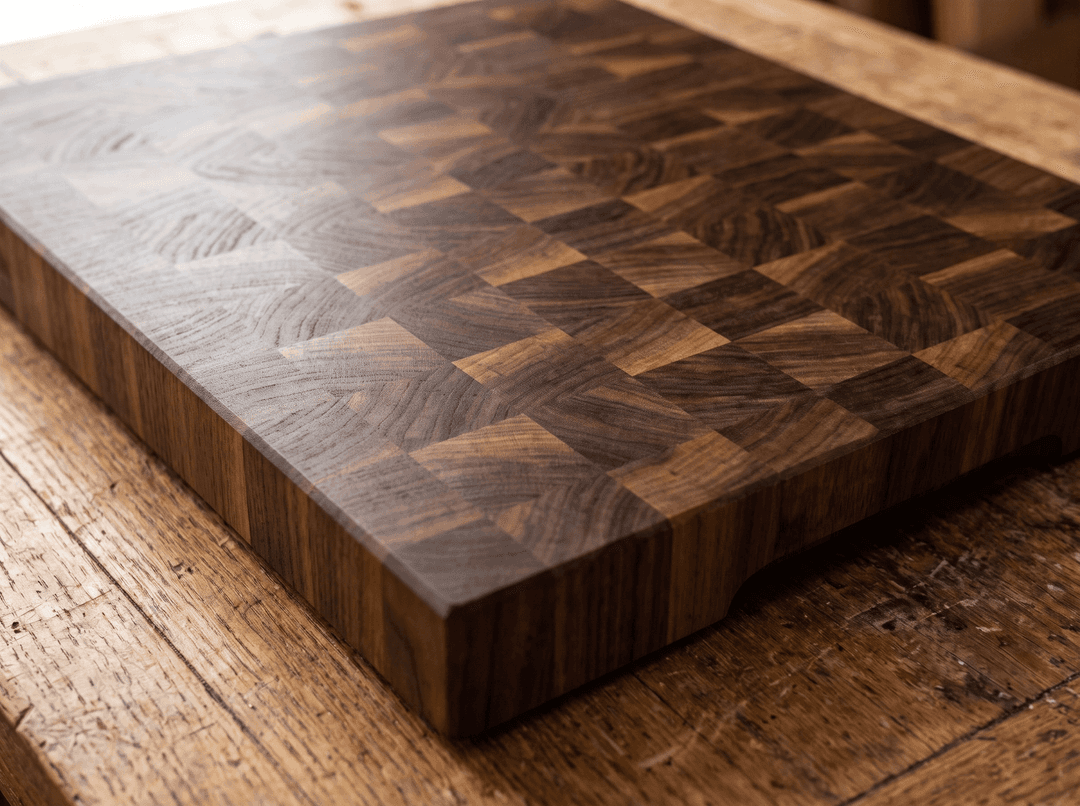
End grain: blocks on end, fibers up — the checkerboard is structural, not decorative.
The full head-to-head — including where each belongs in a kitchen — is in edge grain vs. end grain butcher block.
Two-Species Tops: Built for Visual Impact
- Durability: equal to single-species edge grain when the woods are matched for hardness and movement — walnut with white oak, maple with walnut — which is the only way we build them.
- Cost: single-species edge grain plus a modest premium for the second species and the alternating glue-up.
- Maintenance: identical to edge grain; the two woods age together under the same finish.
- Best use: statement dining tables, bar tops, and hospitality rooms where the top is part of the brand.

Maple + walnut, striped strip for strip — the contrast is the design.
How We Build Them
Every top starts at the lumber rack: grain, moisture content, and color matched by hand, not by invoice. Boards are jointed and ripped; for end grain, they're cross-cut into blocks before the first glue-up. We clamp in stages, cure overnight, run the panel through the wide-belt sander, then finish with the 100% VOC-free hardwax oil, UV-cured to full hardness in the shop. Species hardness and grain behavior — walnut, white oak, maple, and exotics like wenge or padauk — are compared on the materials page.
How Thick Should the Top Be?
Restaurant and commercial tops run 1.5" — the balance of durability, weight, and cost that survives years of bussing; communal spans go 1.75" with steel C-channel underneath. Residential dining tables run 1.25" to 1.75", with 1.5" the sweet spot. End grain starts at 2.5" because the construction demands it. For the commercial side — matched runs, standard footprints, direct-to-site freight — see the restaurant tabletops page.
Cost and Lead Time
At 1.5", finished and freighted: white oak runs $80–$100 per square foot, maple $85–$105, walnut $90–$110 — so an edge grain dining top starts in the low thousands depending on size. End grain and full commercial runs price higher on labor; two-species tops carry the design premium. Current lead time is 4-6 weeks; trade and multi-table restaurant orders schedule directly with the shop. Per-species rates live on the pricing page, and the Builder prices your exact dimensions instantly.
Pick the Build, Then the Wood
Decide how the top will be used, and the construction picks itself — then the species is taste. See it built: our walnut face grain table tops and walnut + white oak edge grain tops are milled to exactly the specs this guide recommends.
dining table, cut to your dimensions.
Each one is milled from solid hardwood to your exact measurements and finished by hand in our Farmingdale shop.
Design yours →Kevin has been designing and building made-to-order solid hardwood countertops, table tops, and shelving in Farmingdale, NY since 2017 — every piece milled and finished in the Hardtwood shop.
More about the shop →