

How Thick Does a Floating Wood Shelf Need to Be to Hold Weight Without Sagging?
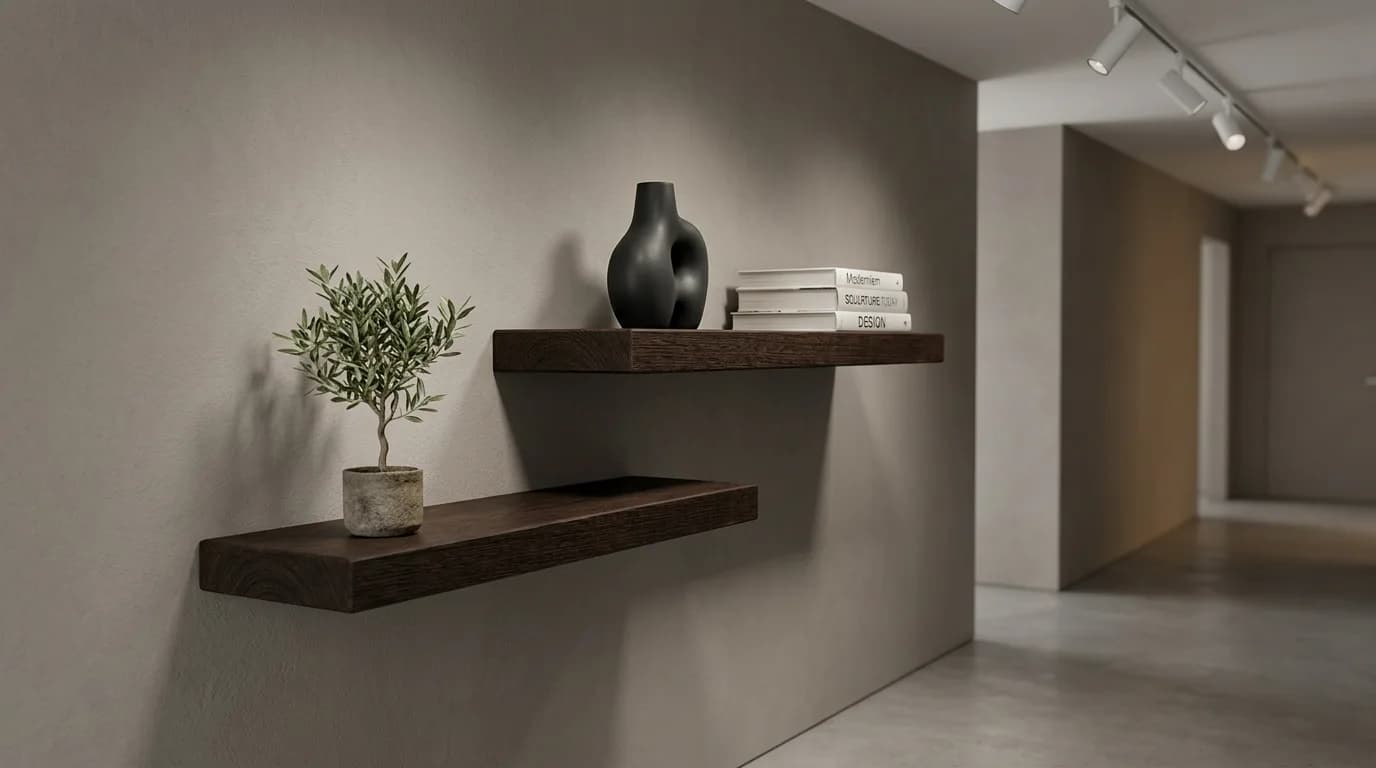
"How thick should a floating shelf be?" is really two questions — how thick the wood needs to be so it doesn't sag, and what's hiding inside it doing the actual carrying. Get either one wrong and the shelf droops within a year. This is the shop math we use on every build: thickness by span and load, the bracket that makes the rating honest, and what a properly built shelf costs.
1.5 Inches for Most Spans
For most spans, a solid hardwood floating shelf needs to be at least 1.5" thick to resist sagging under normal load — books, dishware, decor. That's also the minimum our concealed bracket system requires: below it, there isn't enough wood to rout the rod channels and still leave structure around them. Once a shelf runs past 36" or is meant to carry real weight — a run of cast iron, stacked stoneware, a wall of hardcovers — we build it 1.75" to 2.5" thick and let the bracket do the carrying. Thickness alone doesn't solve sagging; thickness plus the right hidden bracket is what does.
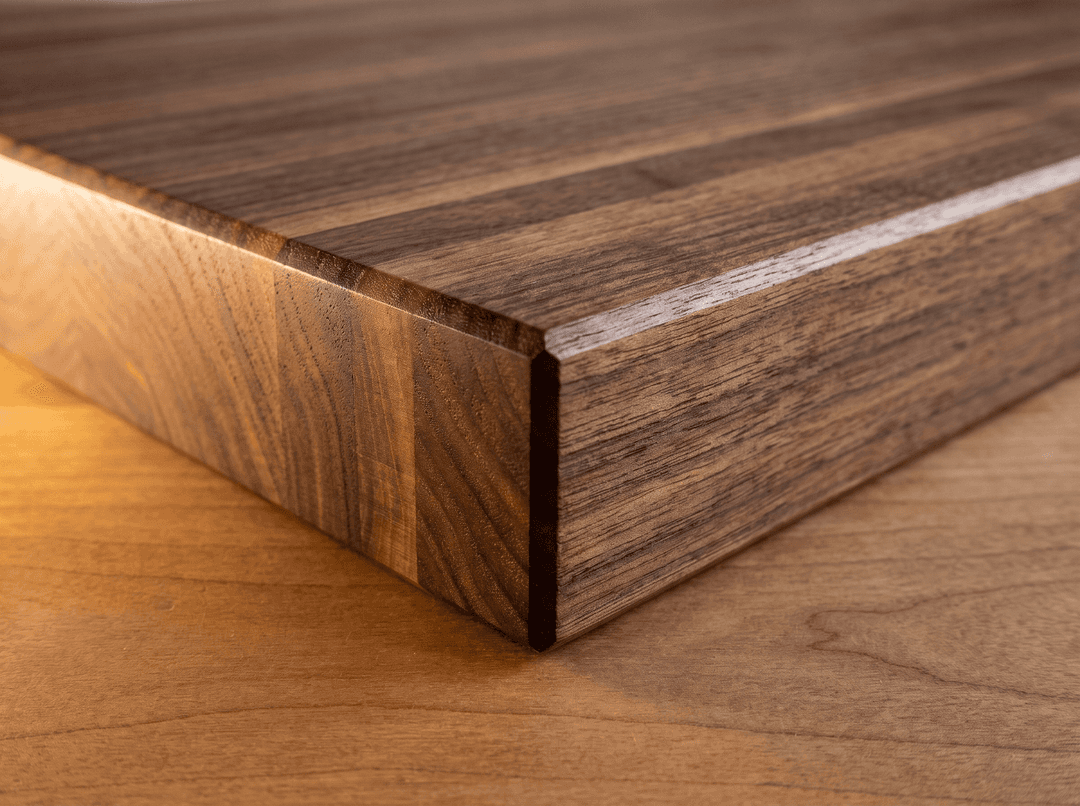
Thickness only counts if it's solid: real grain through the full section, not veneer over a hollow box.
What Thickness Holds What, by Span
Shop-tested ranges, not lumber-yard guesses:
| Thickness | Clean span | Typical duty |
|---|---|---|
| 1.5" | up to 36" | Display and decor — frames, plants, ceramics; 6"–8" deep |
| 1.75" | up to 36" loaded heavy | Books and office — spines flush at 8"–10" deep |
| 1.75"–2" | up to 48" | Kitchen open shelving — dishware at 10"–12" deep, sealed food-safe |
| 2"–2.5" | 36"–60" | Bar shelving, media walls, anything cantilevered with real mass on it |
Species moves the needle at the margins: white oak (1,360 Janka) and hard maple (1,450) flex less than walnut (1,000) at the same thickness, so a long walnut span sometimes gets a quarter-inch bump. The full depth-and-span logic, room by room, is in our floating shelf guide.
The Hidden Bracket Changes the Equation
A floating shelf isn't floating — it's carried entirely by whatever's hidden inside it. Every shelf we ship rides the concealed Hovr system: an aircraft-grade aluminum plate with steel rods, load-tested to 300 lb, lagged directly into studs, brick, or masonry. The rod channels are CNC-routed into your exact shelf in our shop, so there's nothing to align on site and no visible hardware from any angle.
This is the part most off-the-shelf floating shelves get wrong: a thin bracket in thick wood still sags, and a good bracket in a hollow torsion box crushes its own mounting points. We size the shelf's thickness to its span and load before we cut anything — which is why a 2.5" shelf from this shop can carry a mounted television or a run of cast iron without deflection over time. Bracket specs and the two-step install are on the hidden bracket system page.
Thickness Is Where Live Edge Shines
Live edge is where a thicker shelf shows its best side. A 2" to 2.5" slab keeps the full natural edge character intact while giving the bracket the mass it needs underneath. We did exactly this on a walnut live edge bar with matching floating shelves in Huntington Station, NY — same slab lineage as the bar top below, hung on hidden brackets so the shelves read as solid walnut hovering on the wall.
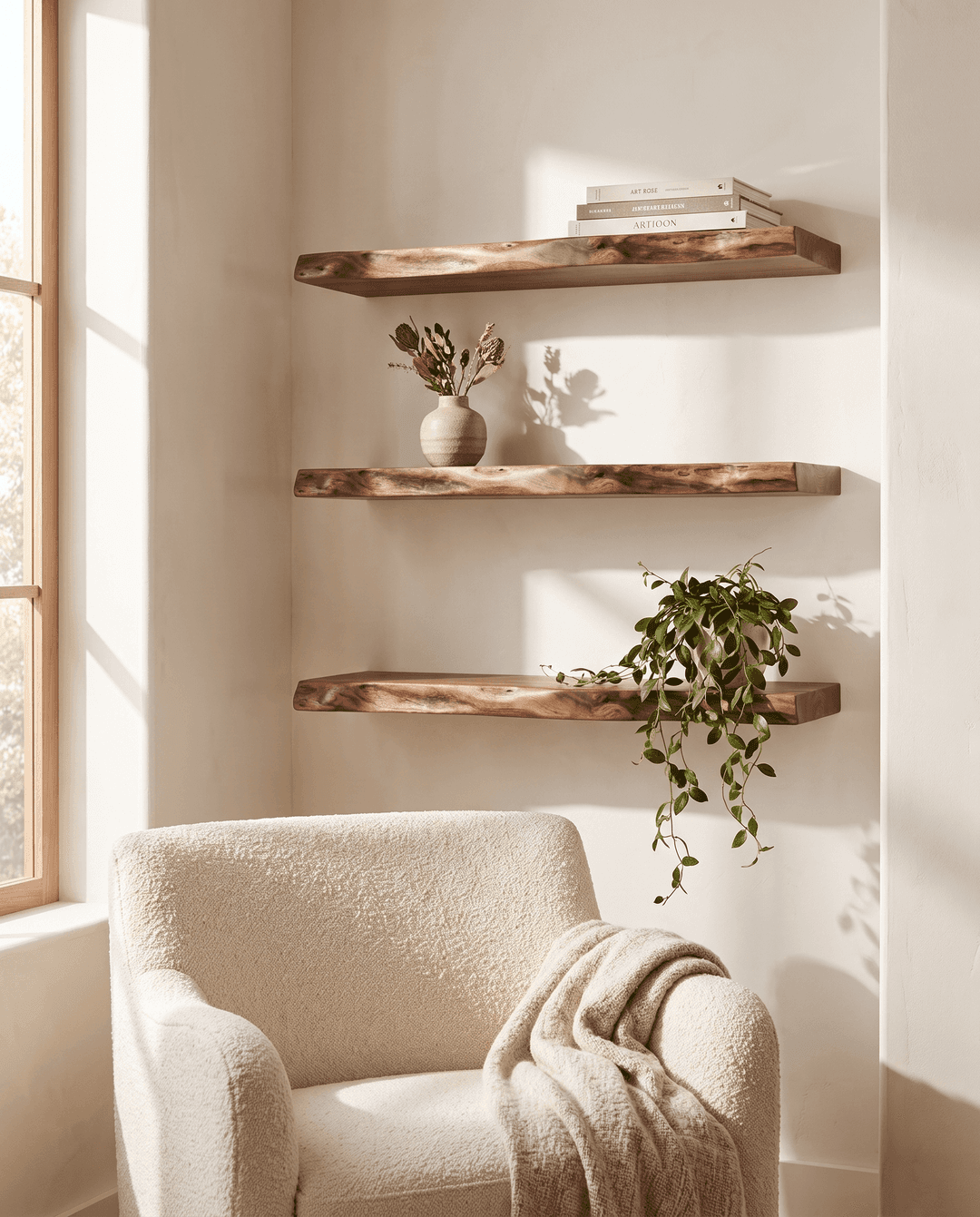
Walnut live edge shelves at 2" — the thickness carries both the look and the load. More in the live edge guide.
Built to the Quarter Inch, Not a Stock Run
Every shelf is made to your wall, not pulled from a size run:
- Lengths from 12" to 96"+ in a single board, longer with a seamless glued joint
- Depths from 6" (display) to 14"+ (working kitchen or bar shelving)
- Thickness from 1.5" to 3", chosen by span and load, not just look
- Species: walnut, white oak, hard maple, cherry, and exotics like wenge or padauk — straight edge or live edge in each
The full range starts at the hardwood floating shelves collection, and every wood is compared side by side in the species guide.
What It Costs and How Long It Takes
A single 36" hardwood floating shelf at 1.75"–2" thick typically runs a few hundred dollars depending on species, with the bracket included — the Builder prices your exact length, depth, and thickness live, no email required. A thick live edge piece at 60"+ runs closer to what a small tabletop costs, because slab selection and the bracket engineering take real shop time. Current lead time is 4-6 weeks from order confirmation, and every shelf ships crated, nationwide.
Start With the Wall, Not the Wood
If you know your span and the rough load, the right thickness falls out of the table above — and the Shelf Builder prices it instantly at your exact dimensions. See it built first: our walnut live edge floating shelves and white oak shelves are milled to exactly the specs this guide recommends.
floating shelf, cut to your dimensions.
Each one is milled from solid hardwood to your exact measurements and finished by hand in our Farmingdale shop.
Design yours →Kevin has been designing and building made-to-order solid hardwood countertops, table tops, and shelving in Farmingdale, NY since 2017 — every piece milled and finished in the Hardtwood shop.
More about the shop →