

End Grain Butcher Block Countertops: Pros, Cons, and Care

An end grain butcher block countertop is built from hundreds of short hardwood blocks stood on end and glued into a grid, so the surface you touch is the end of the fibers — the same construction as a commercial cutting board, scaled up to a full counter. It's the most knife-friendly and most labor-intensive of the solid wood builds, it costs the most, and for an island or prep counter that gets used hard, it's the construction that holds up. Here's the honest ledger: what it does better, what it demands, and what it costs.
Edge Grain vs. End Grain vs. Two-Species
We build all three in solid hardwood — no veneer, no engineered core, ever:
- Edge grain — boards glued on edge showing long grain up top. Most affordable, most stable across a wide island, cleanest linear look. The counter for people who cut on a board.
- End grain — blocks on end in a checkerboard grid. The best surface there is for direct knife work and the most heat-tolerant, at the highest material waste and labor. The counter that IS the cutting board.
- Two-species — walnut with white oak, maple with walnut — in stripes or checkerboard, in either construction. Cost and care track the base build; the premium is layout precision. The statement top.
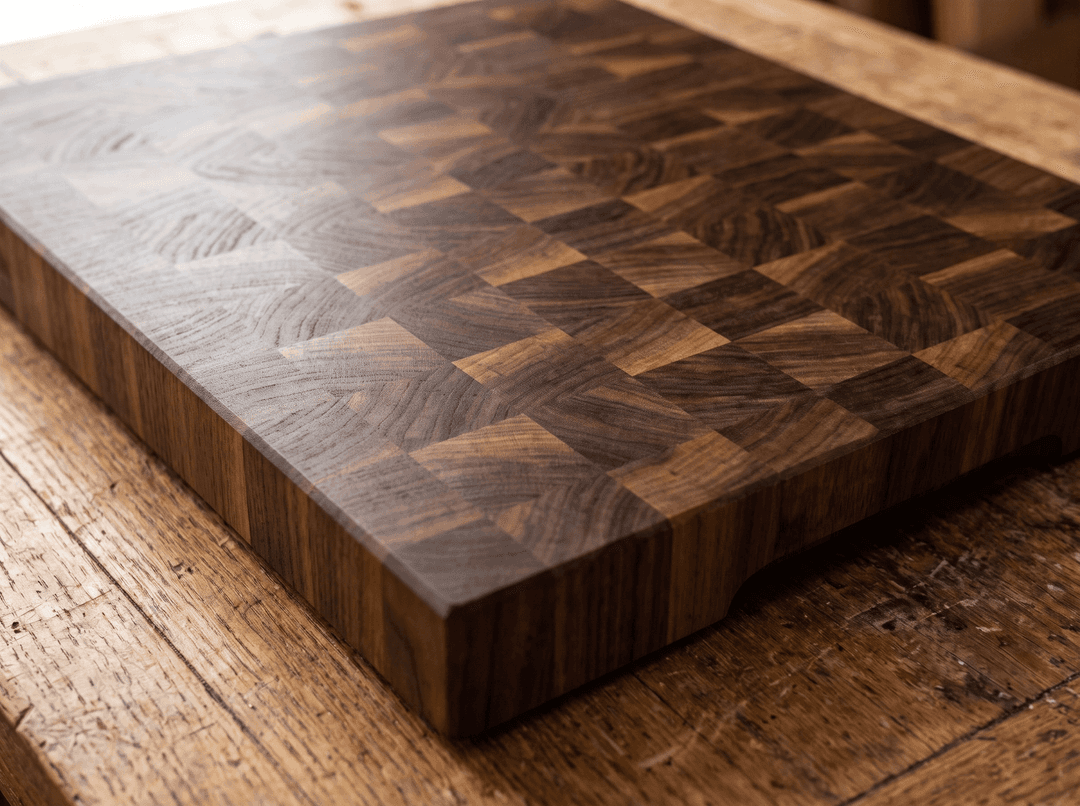
Real end grain: every square is a block's end fibers, and every glue line is structural.
The full decision tree is in edge grain vs. end grain butcher block and the butcher block countertop guide.
How We Build an End Grain Top
We start with straight-grained stock — walnut, white oak, hard maple, or an exotic like iroko — rip it into strips, and crosscut the strips into short blocks. The blocks rotate 90 degrees and re-glue face to face in a jig so every one presents its end grain upward: this is the step that separates real butcher block from anything cut to just look like it. Panels clamp in stages, cure overnight, then run flat through progressive grits before finishing. On multi-species layouts we dry-fit the whole pattern before any glue touches wood — a checkerboard that's off by one block shows for the life of the top.
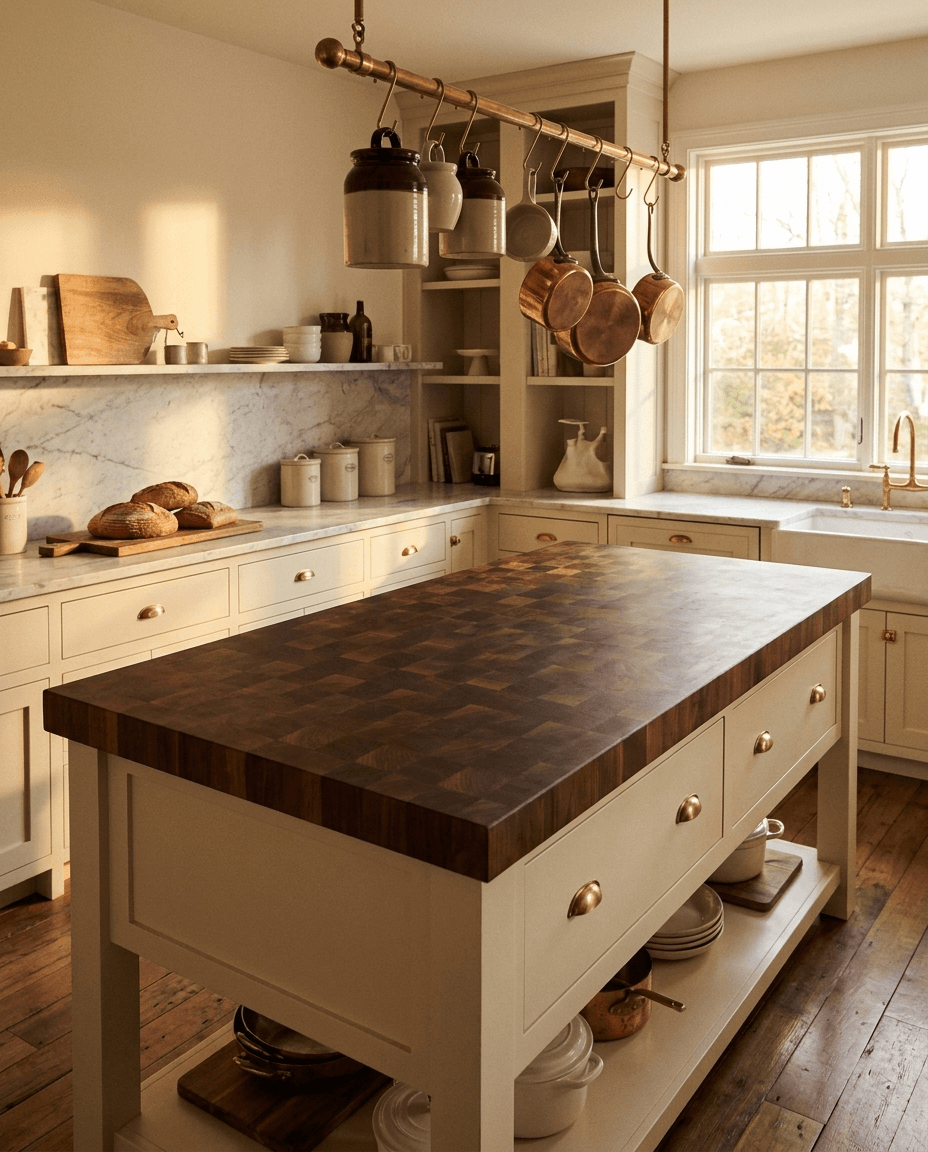
End grain walnut on a working island — 2.5"+ thick because the construction demands it.
See the same shop's construction and finish approach across a bar, countertop, and shelf build in Huntington Station and a kitchen counter with an undermount sink.
Cost and Lead Time
End grain runs materially higher than edge grain — plan on roughly 50 percent over a face grain top at the same footprint, and about 30 percent over edge grain, because end grain consumes significantly more raw board footage per finished square foot and each glue-up stage adds labor. For reference at the standard 1.5" (end grain itself starts at 2.5"): walnut runs $90–$110 per square foot, maple $85–$105, white oak $80–$100, finished and freighted — end grain scales up from there on thickness and block count. Exotic species and two-species layouts push toward the top. Current lead time is 4-6 weeks, with end grain at the top of the window — the glue-up, flattening, and finishing each take more passes. The Builder prices your exact dimensions live; per-species rates are on the pricing page.
Care: More Than Edge Grain, Less Than the Internet Says
Every top we ship arrives sealed with a 100% VOC-free, food-contact-safe hardwax oil, UV-cured to full hardness — so there is no break-in oiling schedule the way raw mineral-oiled block demands. What end grain does ask for:
- Re-oil the work zone as it visibly wears — exposed end fibers drink finish faster than long grain, so the chopping area dulls first. A cloth and ten minutes brings it back.
- Wipe standing water. Every glue line is exposed end grain; it forgives splashes, not puddles.
- Sand and refresh deep grooves in place. This is end grain's quiet advantage — the surface renews repeatedly without a refinisher.
- Prefer the traditional regimen? Order unfinished and run mineral oil and board butter on your own schedule; skip cooking oils, which go rancid.
Species-specific care notes are on the materials page, and the short version of countertop care overall is in wood countertop care.
Order It the Way It'll Be Used
If the counter is the cutting board, end grain earns every dollar; if the board does the cutting, edge grain is the more honest spend. Spec species, construction, and your exact dimensions in the Builder — the price updates live, and every top ships crated with lift-gate freight included in the continental US.
countertop, cut to your dimensions.
Each one is milled from solid hardwood to your exact measurements and finished by hand in our Farmingdale shop.
Design yours →Kevin has been designing and building made-to-order solid hardwood countertops, table tops, and shelving in Farmingdale, NY since 2017 — every piece milled and finished in the Hardtwood shop.
More about the shop →