

Walnut Shelves: What Actually Separates a Real One From a Veneer Board
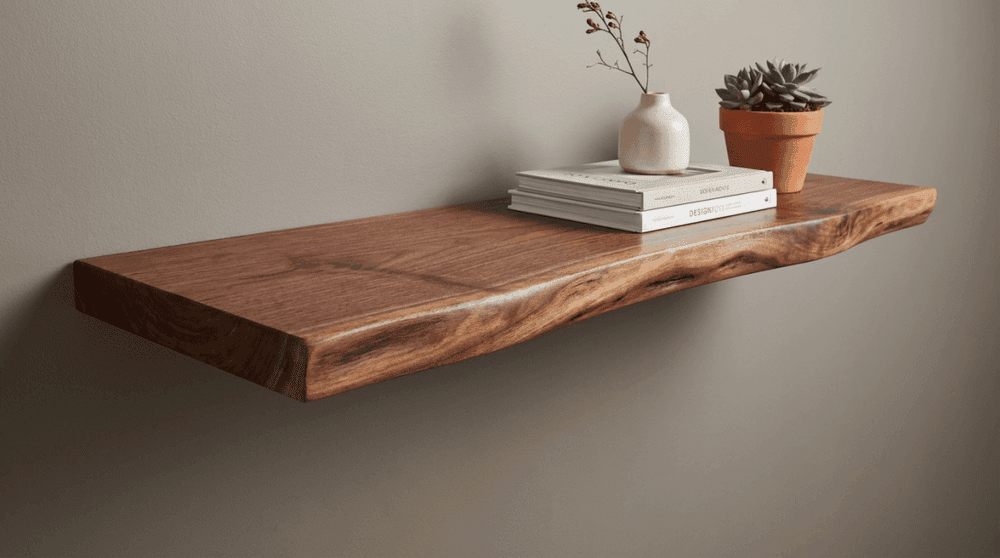
Search "walnut floating shelves" and most of what comes back isn't walnut all the way through — it's MDF or pine wrapped in a walnut-printed veneer, or a hollow torsion box with walnut skin. They photograph fine. They chip at the corners, sag inside a few years, and can't be sanded when they scratch. If you're paying for walnut, you should get walnut: solid, full-thickness, the same board through the whole section. That's the only kind we build, and here's how to tell the difference before you buy.
Look at the Cross-Section
Solid walnut shows continuous grain wrapping from the face through the full thickness. Veneer shows a millimeter of dark skin over a pale core, with a seam where the wrap meets at the corner. Sellers know this, which is why product photos rarely show the end of the board.
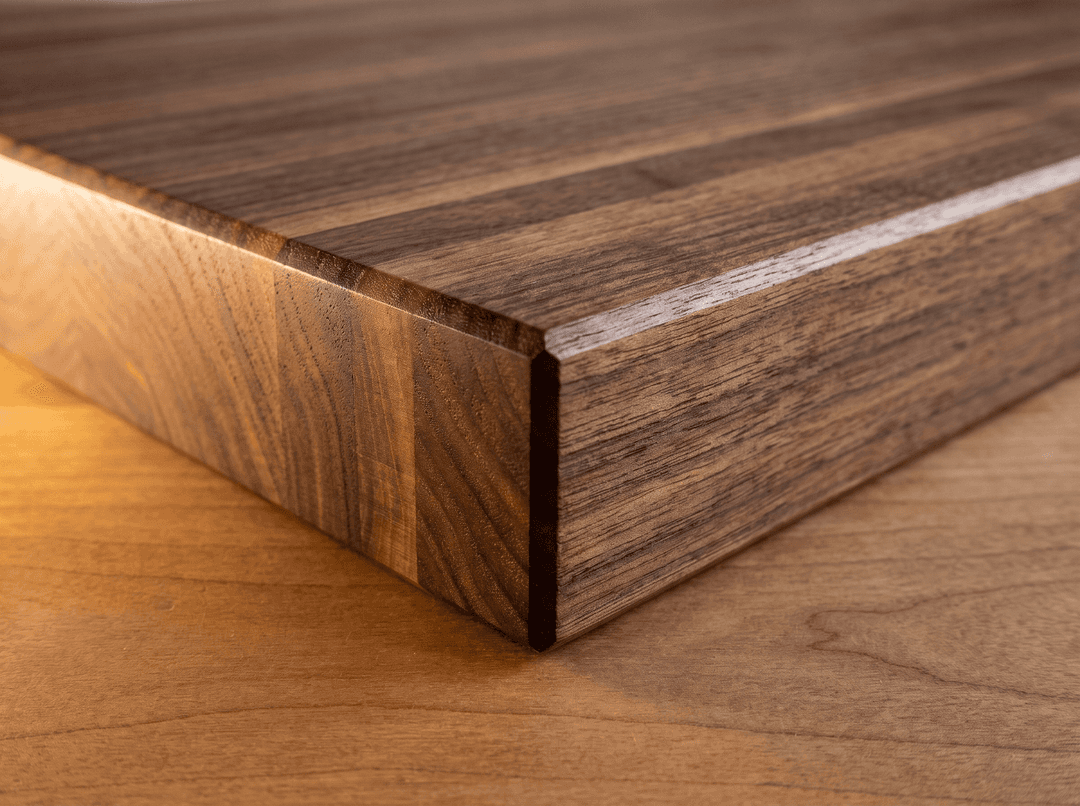
Solid: the grain runs through the whole section, corner included.
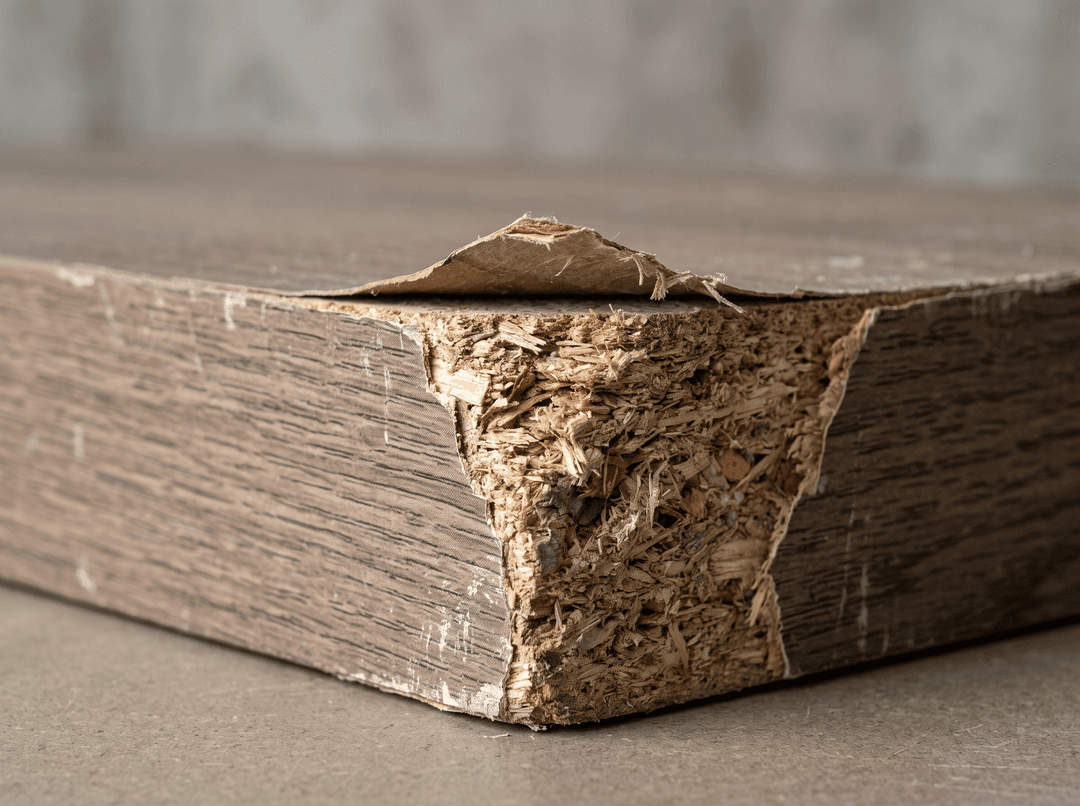
Veneer: a printed skin over compressed sawdust, already letting go at the corner.
Thickness Is the Difference Between a Shelf and a Ledge
Most off-the-shelf floating shelves run 3/4" to 1" thick because that's cheap to ship and easy to hide flimsy hardware in. Solid walnut wants more mass to hold weight without deflecting: we build most walnut shelves at 1.5" to 2" thick, which is also what makes them read as substantial instead of a plank glued to the wall. Thicker stock is what lets us rout the channels for a real concealed bracket — the system every shelf ships on is load-tested to 300 lb, an aluminum plate with steel rods lagged into studs or masonry, invisible from every angle. The span-by-span math is in how thick a floating shelf needs to be, and the hardware is on the hidden bracket page.
Walnut Isn't One Look
Plain-sawn walnut gives cathedral grain; a live edge board keeps the tree's own line on the front — dark heartwood meeting the pale sap line, the shelf that reads as sculpture. Both are the same solid construction on the same bracket. The live edge side of the story, across shelves, counters, and table tops, is in the live edge guide; how walnut compares to white oak, cherry, and maple is in the walnut species guide.
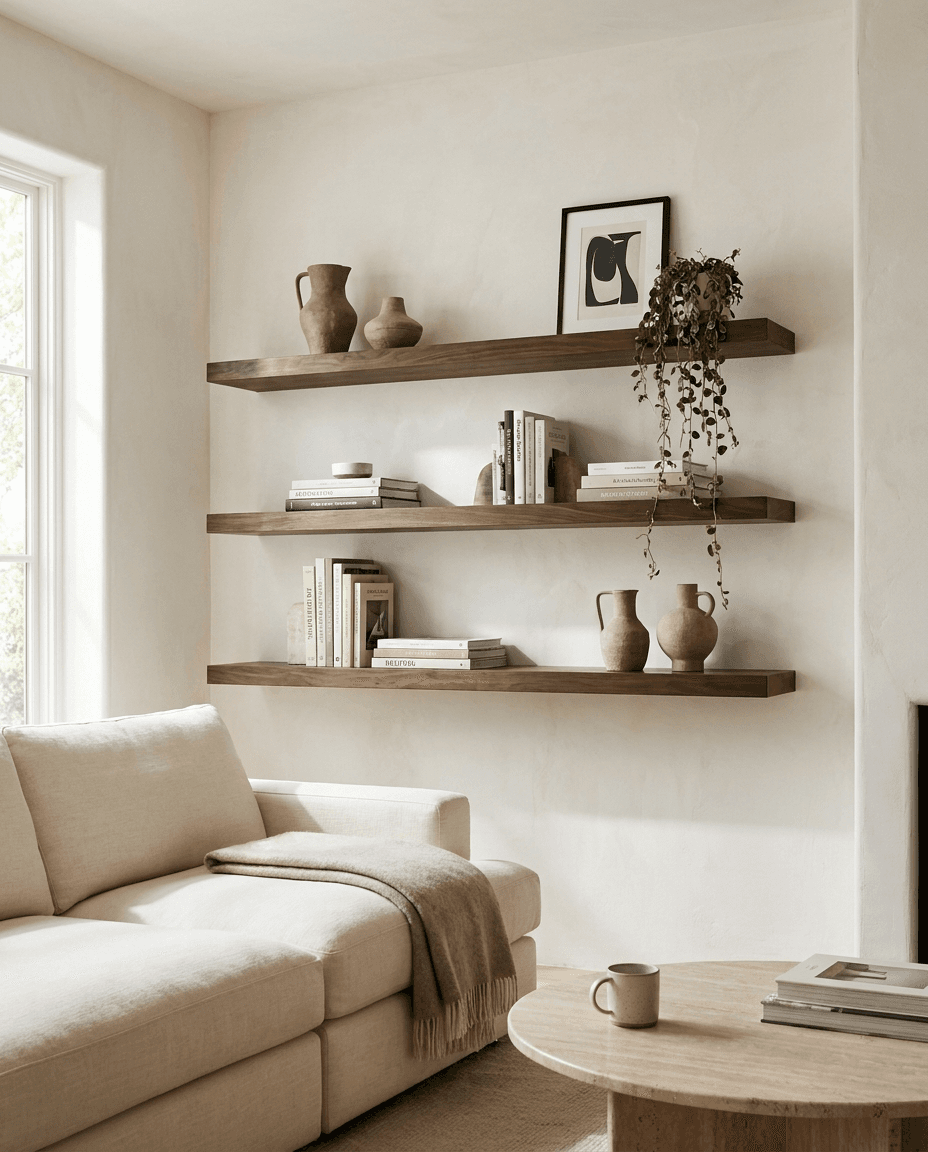
Solid walnut, live edge, no visible hardware — the look veneer boards imitate.
Matching Shelves to Bigger Pieces
Most of our walnut shelf orders arrive alongside a walnut countertop, island top, or dining table for the same room — one wood story instead of mismatched pieces bought from different places over the years. Because everything comes off the same racks under the same finish, shelves, counters, and tables actually match on purpose: same species, same tone, same hardwax oil. For designers, GCs, and restaurant owners speccing multiple pieces, that's worth a conversation early — we spec a matched run across the countertop, tables, and shelving in one order. Trade pricing applies; start at the trade program.
Finish and Real-World Care
Walnut shelves get the same finish as our countertops: a 100% VOC-free hardwax oil, UV-cured in the shop — food-safe for kitchen shelving, durable enough for commercial spaces. Walnut mellows slightly with light over time, which most people like. It will show life eventually — and unlike veneer, it sands and re-oils in place, for decades.
Sizing, Ordering, and Cost
Built to order from real lumber, sizing is flexible to the quarter inch — which matters for an odd kitchen wall or a commercial run. A 36" solid walnut shelf at 1.75"–2" typically lands in the few-hundred-dollar range, bracket included; the Shelf Builder prices your exact length, depth, and thickness live. Current lead time is 4-6 weeks. See the real thing: walnut floating shelves and walnut live edge floating shelves, both solid through the section.
Walnut floating shelf, cut to your dimensions.
Each one is milled from solid Walnut to your exact measurements and finished by hand in our Farmingdale shop.
Design yours →Kevin has been designing and building made-to-order solid hardwood countertops, table tops, and shelving in Farmingdale, NY since 2017 — every piece milled and finished in the Hardtwood shop.
More about the shop →