

Round Wood Table Tops: Sizes, Seating, and What They Really Cost
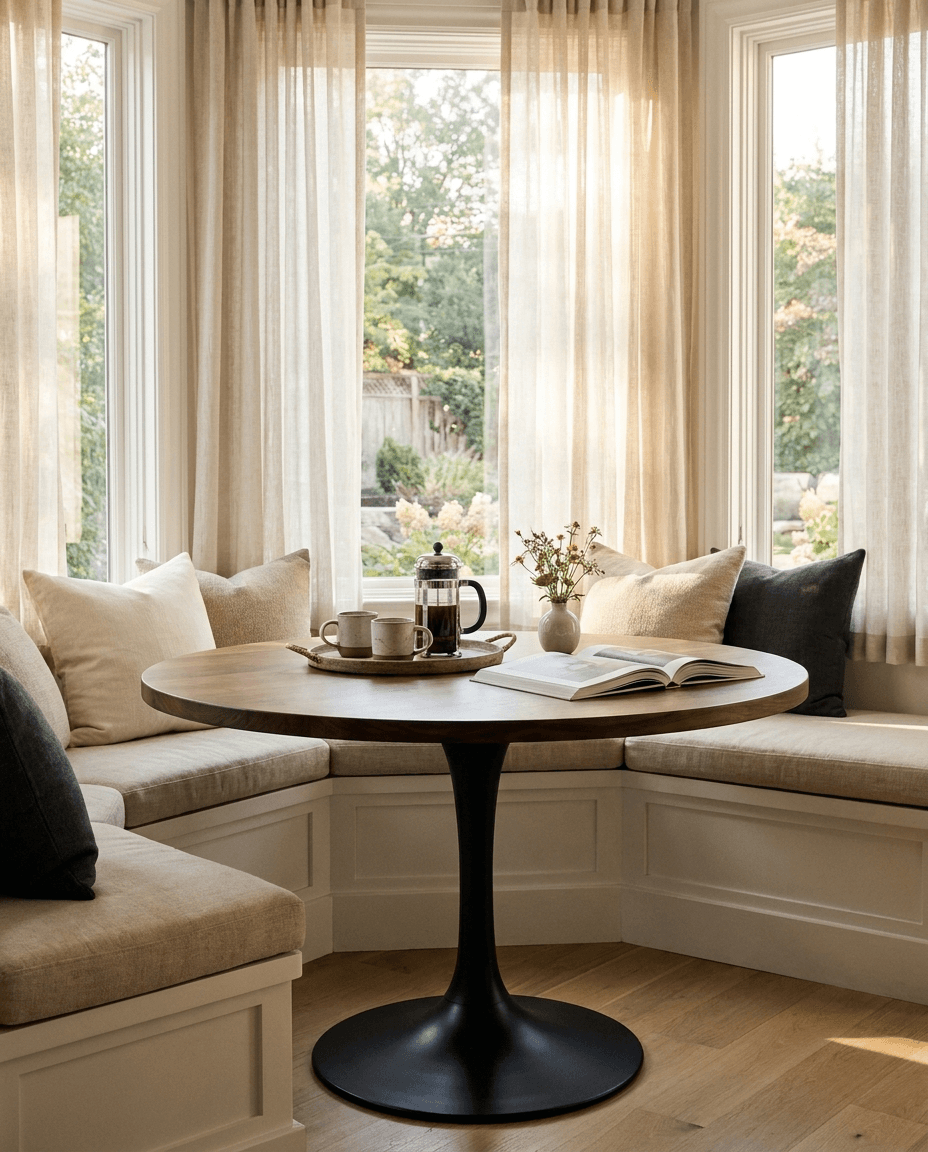
A round wood table top is the one piece of furniture where the first decision — diameter — sets almost everything else: how many chairs fit, whether the room still has a walkway, what base will carry it, and what you pay. Most size guides stop at a seating chart. This one adds the part the chart leaves out: how a solid hardwood circle is priced, and why two inches of diameter can cost more than you expect.
Hardtwood Custom Woodworks builds round table tops to the inch in our Farmingdale, NY shop, in 15 solid hardwoods, from 24 inches to well past 72. What follows is the math we use with customers every week.
How Many People a Round Table Top Seats
Seating on a circle comes down to edge length. Each diner needs roughly 24 inches of perimeter for a comfortable place setting, 20 inches if you are squeezing in for a holiday. Perimeter is diameter × 3.14, so the chart writes itself:
- 36″ — 113″ of edge: 4 seats comfortably. Café two-tops and breakfast nooks.
- 42″ — 132″: 4 seats with elbow room, 5 in a pinch.
- 48″ — 151″: 5 to 6. The most common dining diameter we cut.
- 54″ — 170″: 6 to 7.
- 60″ — 188″: 7 to 8, and the point where a single pedestal base starts to work hard.
- 72″ — 226″: 8 to 10. Conference rooms and big family kitchens; plan for a lazy Susan or nobody reaches the center.
Two corrections to the usual version of that chart: the numbers assume chairs around 18 inches wide, and they assume a clear floor. A round table top needs 36 inches from its edge to the nearest wall for chairs to pull out, 42 inches if people walk behind the seated. Subtract 72 to 84 inches from the narrower room dimension and you have your maximum diameter. A 12-foot-wide room tops out around 60 inches.
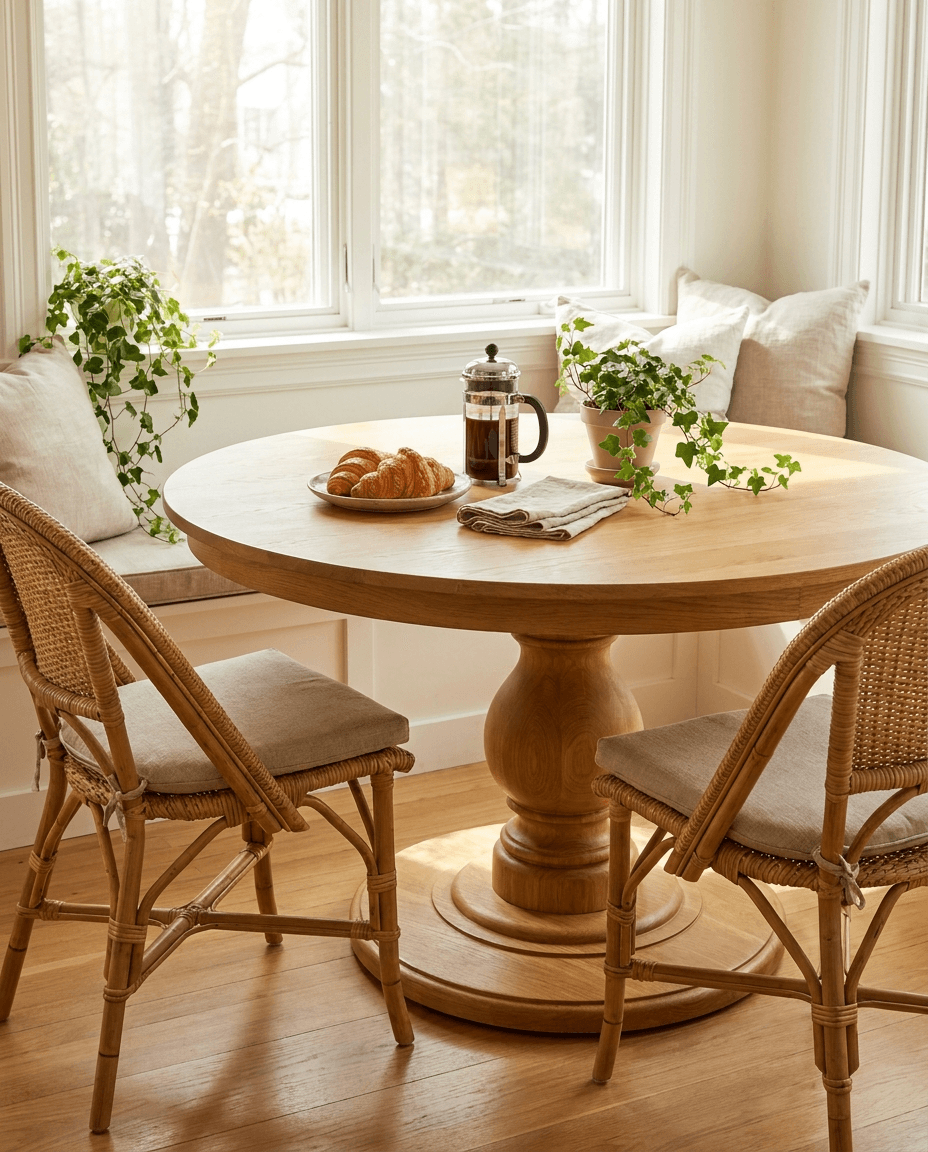
The chart in practice: a white oak round holding a breakfast nook without crowding the walkway.
Why the Square Blank Sets the Price
A solid wood round table top does not start round. We glue up a rectangular panel of boards, flatten it on the CNC, and only then cut the circle. The offcuts at the corners are real lumber, already milled, and they do not go back on the rack as usable stock.
So a 48-inch round is priced on the 48 × 48 blank it is cut from: 16 square feet, not the 12.6 square feet of the finished circle. At our walnut rate of $90 per square foot at 1.5 inches thick, that is $1,440 delivered — which is exactly what the Builder shows for a 48″ walnut round top today. A 48-inch rectangle of the same wood at 48 × 36 is 12 square feet, $1,080. The circle costs 33% more for the same longest dimension because it uses 33% more wood.
The practical consequence: on a round top, every inch of diameter is paid for twice, once in length and once in width. Going from 48 to 54 inches adds 4.25 square feet of blank, roughly $380 in walnut. From 54 to 60 adds another 4.75 square feet. If the seating chart says 54 will do, 54 is the number.
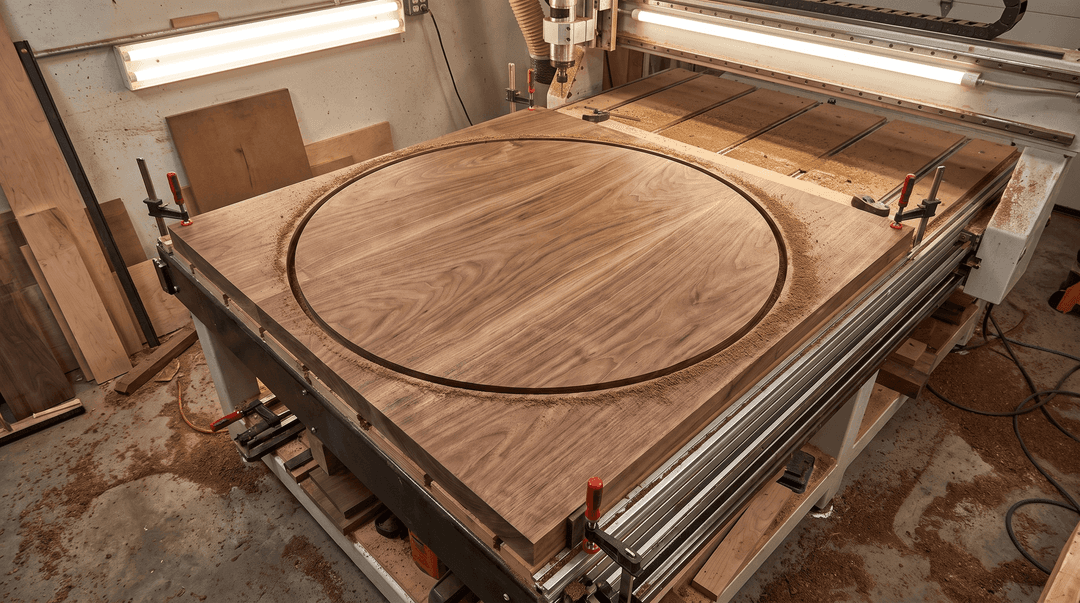
The square-blank rule, on the machine: the circle comes out of a full square of milled walnut.
Round Table Top Prices by Diameter
Using our current finished rates — walnut $90 to $110 per square foot, white oak $80 to $100, maple $85 to $105, cherry $75 to $90, all at 1.5 inches thick with fabrication, the UV-cured hardwax oil finish, and free lift-gate freight included — the square-blank math gives these real figures:
A 36-inch round is a 9 square foot blank: about $720 in white oak, $810 in walnut. A 42-inch round is 12.25 square feet: roughly $980 oak, $1,100 walnut. A 48-inch round is the 16 square feet above: $1,280 oak, $1,440 walnut. At 54 inches the blank is 20.25 square feet: around $1,620 oak, $1,820 walnut. A 60-inch round is 25 square feet: about $2,000 oak, $2,250 walnut. At 72 inches you are at 36 square feet and into the oversize tier, since the blank is wider than 4 feet: expect $3,200 to $3,600 in oak and $3,600 to $4,000 in walnut.
These are the low end of each species range at the standard thickness. Live edge is not an option on a round — there is no natural edge on a circle — so round tops never see the top of the range that live-edge slabs do. Thicker tops scale with the wood: a 2-inch top costs a third more than 1.5, and a 1.25-inch top about 17% less. The exact number for your diameter, species, and thickness is on the Round Tabletop in the Builder.
Which Thickness for a Round Top
Thickness on a round is more about feel and base than strength. A 1.25-inch solid hardwood circle at 48 inches will not sag; glued-up face-grain panels are far stiffer than the veneered MDF tops on most mass-market round tables, which need an apron to stay flat. We recommend 1.5 inches for dining rounds up to 60 inches because the edge profile reads better and the top has visual weight against a pedestal. Above 60 inches, 1.75 or 2 inches keeps the overhang from looking thin, and the extra mass helps the top sit dead flat on a single-column base.
Weight matters for round tops more than rectangles because they so often sit on one pedestal. A 48-inch walnut top at 1.5 inches is about 120 pounds. A 60-inch top at 1.75 inches approaches 220. Ask the base maker for its rated top weight and maximum overhang before you order; most cast-iron restaurant bases are rated for a 36 to 42-inch round, and a 30-inch cross base is the minimum for a 48-inch home dining top.
Species That Suit a Circle
Grain reads differently on a round top because the boards run one direction across a shape with no straight reference. Walnut is the most requested for that reason: the color variation across boards becomes the pattern, and the 1,000 lbf Janka rating is plenty for dining. White oak at 1,360 lbf is the hard-wearing choice for restaurants and families with young kids, and quarter-sawn white oak gives a round top the ray-fleck figure that reads well at every angle. Hard maple at 1,450 lbf takes stain evenly and suits a painted or black-stained base. Cherry darkens from salmon to deep red over the first year, which looks intentional on a circle.
Every species we cut is solid hardwood straight through: boards glued up, CNC-milled flat, hand-sanded, and finished with a UV-cured, 100% VOC-free, food-safe hardwax oil. No veneer, no MDF core, so the edge profile — eased, chamfered, quarter-round, cove and bead, or Roman ogee — is cut into the same wood you see on the face. A quarter-round or ogee edge is the traditional choice on a round dining top; a crisp eased edge is what most designers specify for café and commercial rounds.
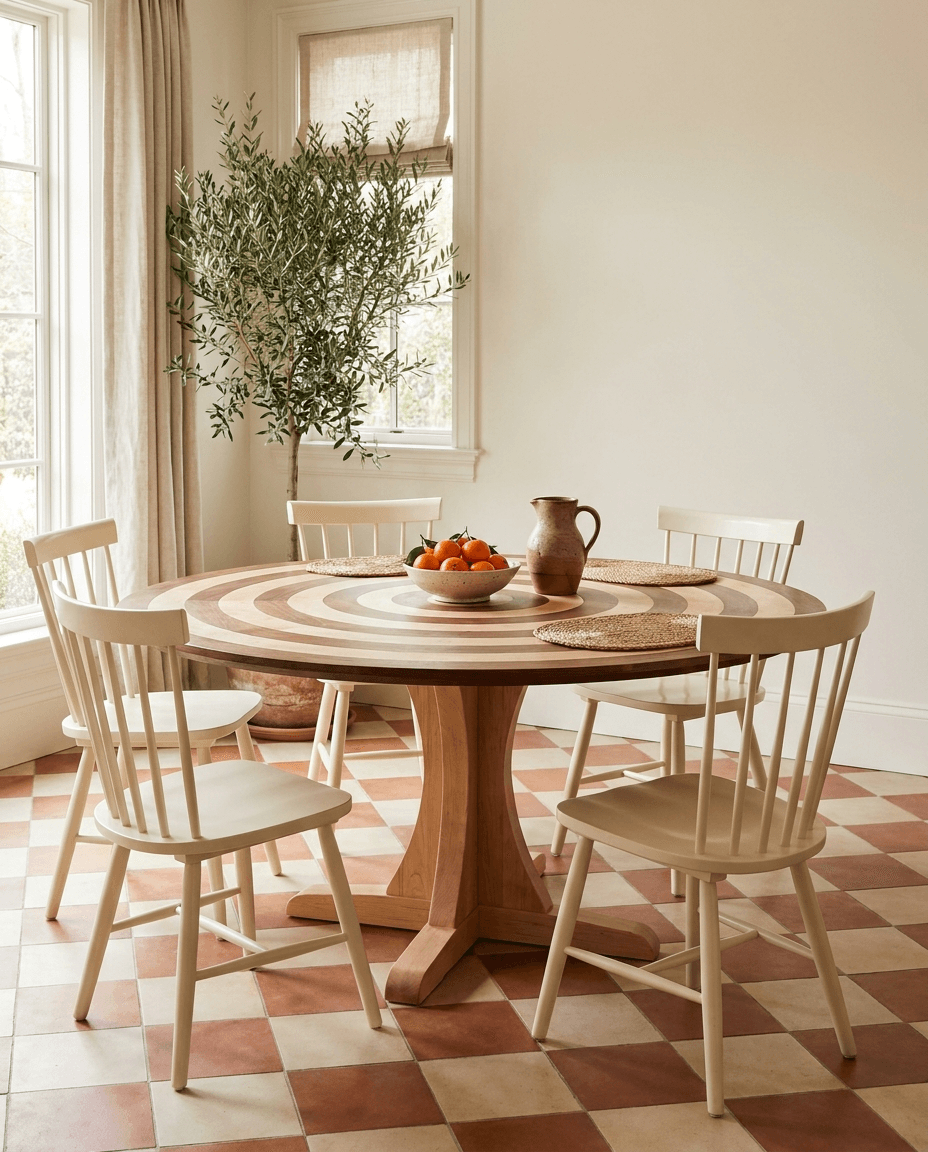
Grain becomes the pattern on a circle — here a maple + walnut two-tone round.
Replacing a Round Table Top
A round table top replacement is one of the most common things we build, because bases outlive tops. Measure the old top's diameter and thickness, then measure the base's top plate and its widest footprint. The new top should overhang the base footprint by at least 10 inches on a pedestal so knees clear the column, and the plate should sit within the middle third of the diameter. If the old top was 1 inch veneer, a 1.5-inch solid replacement adds 60 to 80 pounds; confirm the base will take it.
We pre-drill nothing on round tops unless you send a plate template, because every base is different. Most pedestals attach with four lag screws through the plate; we supply the top flat and finished, and the fastening takes fifteen minutes.
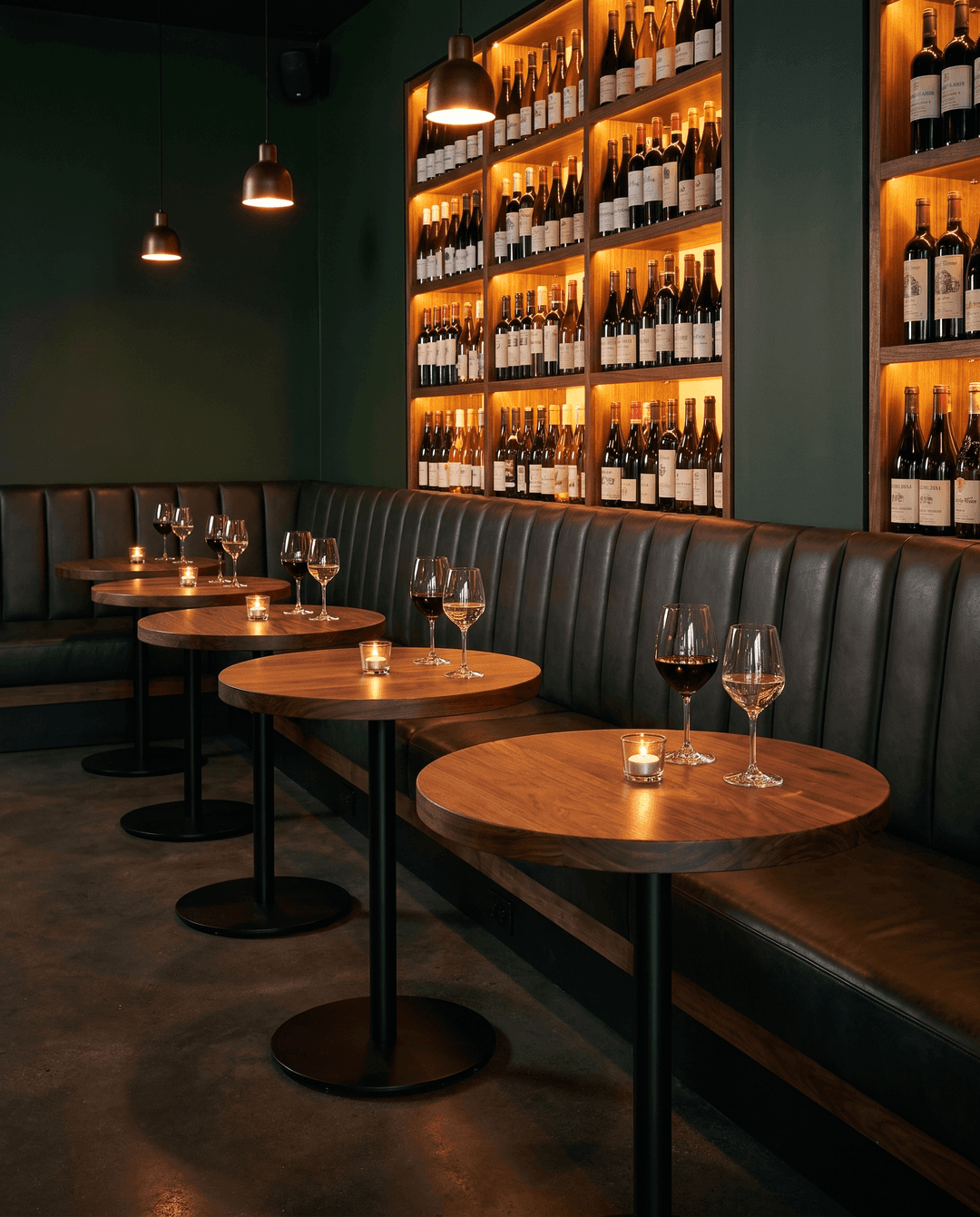
Rounds on single-column bases — the pairing that makes plate size and overhang math matter.
Spec the Diameter, See the Price
The seating chart tells you the smallest diameter that works. The square-blank rule tells you why to stop there. Pick your species and diameter on the Round Tabletop in the Builder, or start from the walnut round tabletop and adjust; the delivered price, weight, and ship window update as you type. If you want the whole rate card first, the finished price per square foot by species is published on the pricing page. Current lead time is 4-6 weeks, and every top ships crated, nationwide.
White Oak table top, cut to your dimensions.
Each one is milled from solid White Oak to your exact measurements and finished by hand in our Farmingdale shop.
Design yours →Kevin has been designing and building made-to-order solid hardwood countertops, table tops, and shelving in Farmingdale, NY since 2017 — every piece milled and finished in the Hardtwood shop.
More about the shop →