

Wood vs. Quartz Countertops: An Honest Comparison
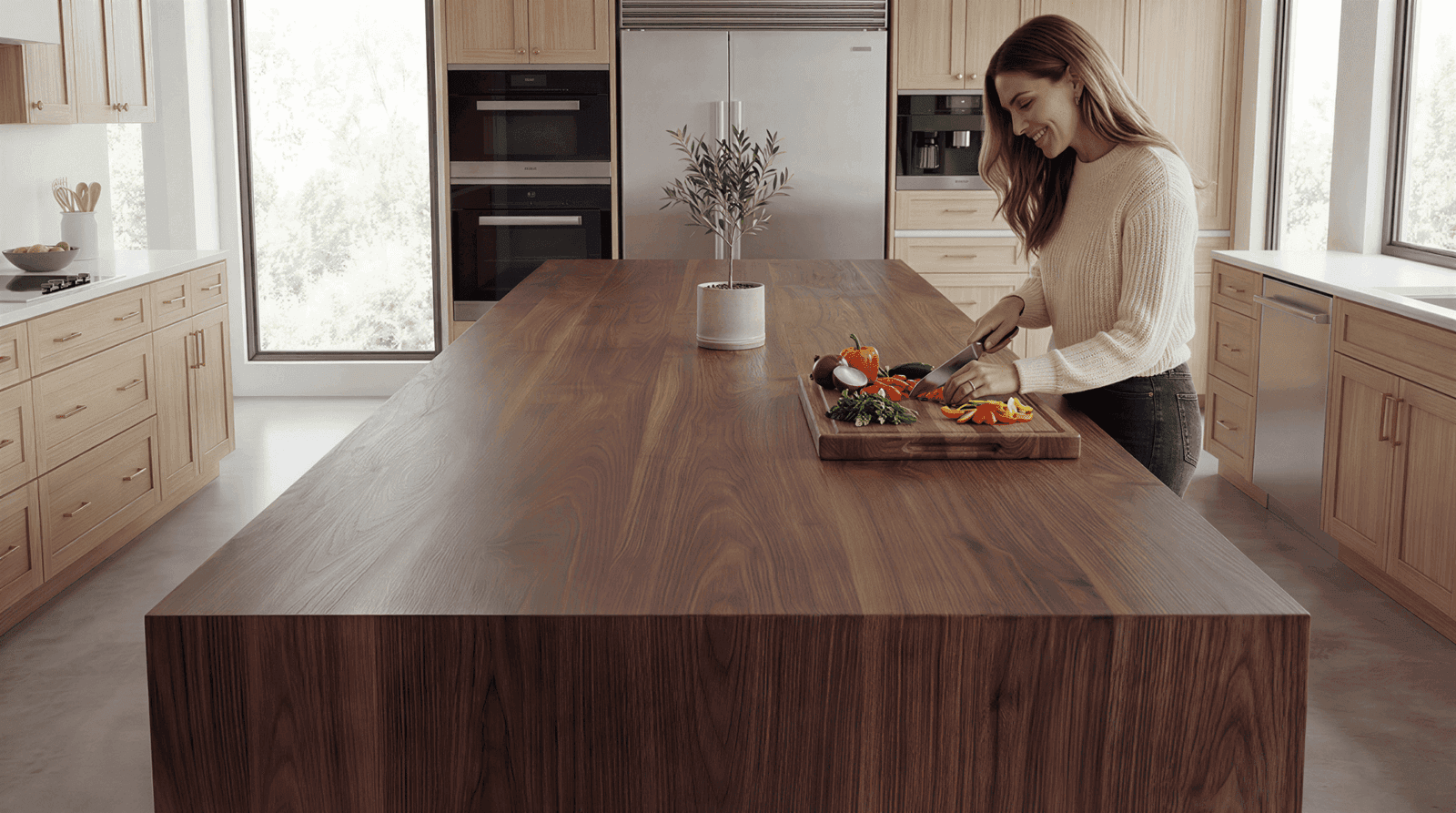
We build solid hardwood countertops for a living, so you'd expect this comparison to be rigged. It isn't — quartz is a genuinely good surface, and for some kitchens it's the right call. But most of what shoppers read about wood vs. quartz is written by stone fabricators or content farms, so here's the comparison from the other side of the shop floor: where quartz wins, where solid wood wins, and the hybrid approach designers keep landing on.
The quick verdict
Choose quartz if you want a zero-thought surface in a heavy-splash zone and don't mind that every slab of it looks manufactured. Choose solid wood if you want warmth, a surface that can be renewed for generations, and a kitchen that doesn't look like every other kitchen on the block. Choose both if you can — the wood island with quartz perimeter is the best-of-both kitchen for a reason.
Cost
Installed quartz typically runs $70–$150 per square foot once fabrication, templating, and installation are in. Our custom solid hardwood tops run $70–$115 per finished square foot delivered — milled to your exact dimensions, finished food-safe, freight included (live ranges by species are on our pricing page). Installation is also simpler: a wood top can be set and fastened by a competent carpenter or a handy homeowner, with no crane, no seam polishing, and no stone crew.
Durability & repair — the part nobody frames honestly
Quartz is harder. It shrugs off knives and won't dent. But here's the asymmetry: when quartz chips or cracks — usually at an edge or around the sink — the repair is a filled patch that never disappears, and a serious crack means replacing the slab. Wood scratches and dents more easily, but every one of those marks sands out. A solid hardwood top can be refinished to literally new condition in an afternoon, decades into its life. One material resists damage; the other recovers from it. Over a 30-year kitchen, recovery wins more often than people expect.
Heat
Neither wants a 400°F pan set directly on it. Quartz's resin binder scorches and discolors permanently around 300°F — a common and unrepairable failure. A scorch mark on wood is real damage too, but it sands out. Use a trivet on either; only one forgives you when you don't.
Water & hygiene
This is quartz's home turf: it's non-porous and doesn't care about standing water. A modern hardwax-oil finish closes most of the gap — our tops are sealed with a 100% VOC-free finish that beads spills and handles sink surrounds and bar service — but wood asks one thing of you: wipe up standing water rather than leaving it overnight. On hygiene, wood's reputation is outdated: studies going back to UW-Madison's food-safety research found wood surfaces harbor fewer surviving bacteria than plastic — properly finished wood is a food-safe surface, full stop.
Look & feel
Quartz is engineered to be uniform — that's its promise and its ceiling. It reads as cool, hard, and identical from slab to slab. Solid hardwood is the opposite: we hand-pick boards for their grain and arrange them so the figure flows across the top, and no two are alike because no two trees are. Wood is warm to the touch, quiet under a dropped glass (ask anyone with stone counters about the chime), and it ages into character instead of out of fashion.
Sustainability
Quartz is roughly 90% mined stone bound in petroleum-based resin, and its fabrication dust is a documented silicosis hazard for the workers who cut it. Hardwood is a renewable material that stores carbon for the life of the top, sources responsibly from managed North American forests, and — because it refinishes instead of replacing — tends to stay out of the landfill for generations.
Where quartz genuinely wins
- Rental units and flips, where zero maintenance beats character
- Heavy-splash perimeter runs around sinks and dishwashers, if you don't want to think about water at all
- Exact color-matching across a large multi-surface project
Where solid wood wins
- Islands, bars, and breakfast counters — anywhere people gather and touch the surface
- Kitchens designed to be warm rather than showroom-cold
- Any surface you intend to keep for decades: refinishable beats replaceable
- Budget-conscious projects that still want a premium surface — delivered wood undercuts installed stone more often than not
The designer's answer: both
The most common kitchen we build for is quartz or stone on the perimeter and a solid walnut or white oak island top in the middle — the practical material where the splashing happens, the beautiful one where the people are. If that's your kitchen, the island is exactly what our Builder prices in about a minute, cut to your cabinet run's exact dimensions, with the edge profile of your choice at no charge.
Still weighing formats within wood? Read our butcher block vs. solid wood guide, or compare species side by side in the species guide.
countertop, cut to your dimensions.
Each one is milled from solid hardwood to your exact measurements and finished by hand in our Farmingdale shop.
Design yours →Kevin has been designing and building made-to-order solid hardwood countertops, table tops, and shelving in Farmingdale, NY since 2017 — every piece milled and finished in the Hardtwood shop.
More about the shop →