

Butcher Block vs. Wide-Plank Wood Countertops
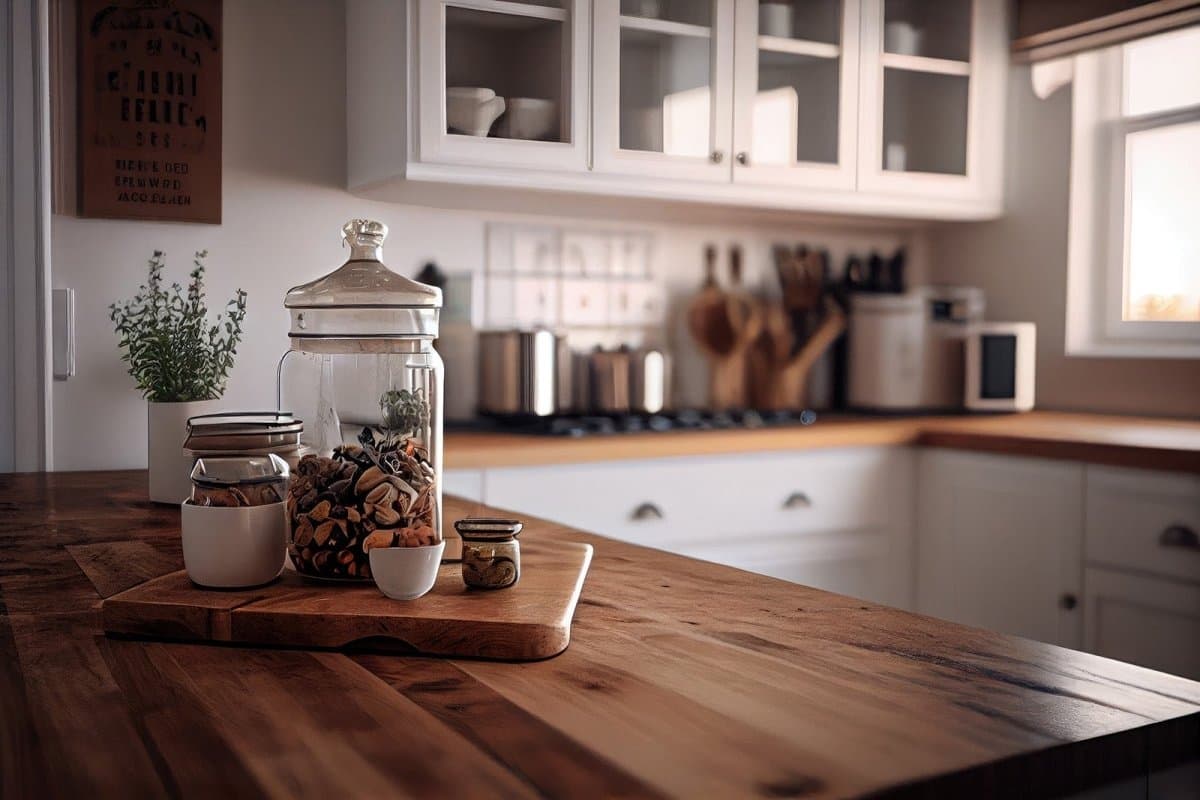
Two wood counters can share a species and a finish and still be entirely different objects, because construction — how the boards become a slab — decides how the top looks, moves, and lives. The real divide is strips versus planks: butcher block versus wide-plank. We build both, so here's the comparison without a thumb on the scale.
Butcher block: many strips, one workhorse
Traditional butcher block is edge-grain construction: narrow strips laminated on edge, or end-grain blocks standing fibers-up in the checkerboard. The virtues are real — a stiffer, dimensionally calmer panel, a surface you can genuinely cut on (end grain), and a workshop honesty that suits farmhouse and industrial rooms. The trade: the surface reads as a pattern of pieces. Strips repeat every inch or two; the wood's large-scale figure never gets room to speak.
Wide-plank: fewer boards, the furniture read
A wide-plank (wide-stave) top is built from full-width face-grain boards — hand-picked, arranged so the cathedral grain flows across the surface like a single slab. It's the construction furniture makers use when the wood itself is the point, and it's our standard line. Properly milled and, on long spans, steel-reinforced, it stays dead flat for decades — the stability gap with butcher block is a solved problem in a real shop.
The decision in four lines
- Show the tree → wide-plank. Walnut cathedrals need width to exist.
- Cut on it daily → end-grain butcher block, the knife-work build.
- Linear, calm, workshop look → edge grain.
- Budget: big-box butcher block is cheap because it's finger-jointed offcuts; custom versions of either construction price by wood volume plus build — all live in the Builder, with construction as a one-tap choice.
One more distinction that matters
Repairs favor both — solid wood is solid wood — but pattern repair favors strips less than you'd think: a refinish renews either completely. What can't be fixed is a look you fell out of love with, so choose with samples in hand ($10 each) and the deeper comparison in mind: butcher block vs. solid wood, the full guide.
countertop, cut to your dimensions.
Each one is milled from solid hardwood to your exact measurements and finished by hand in our Farmingdale shop.
Design yours →Kevin has been designing and building made-to-order solid hardwood countertops, table tops, and shelving in Farmingdale, NY since 2017 — every piece milled and finished in the Hardtwood shop.
More about the shop →